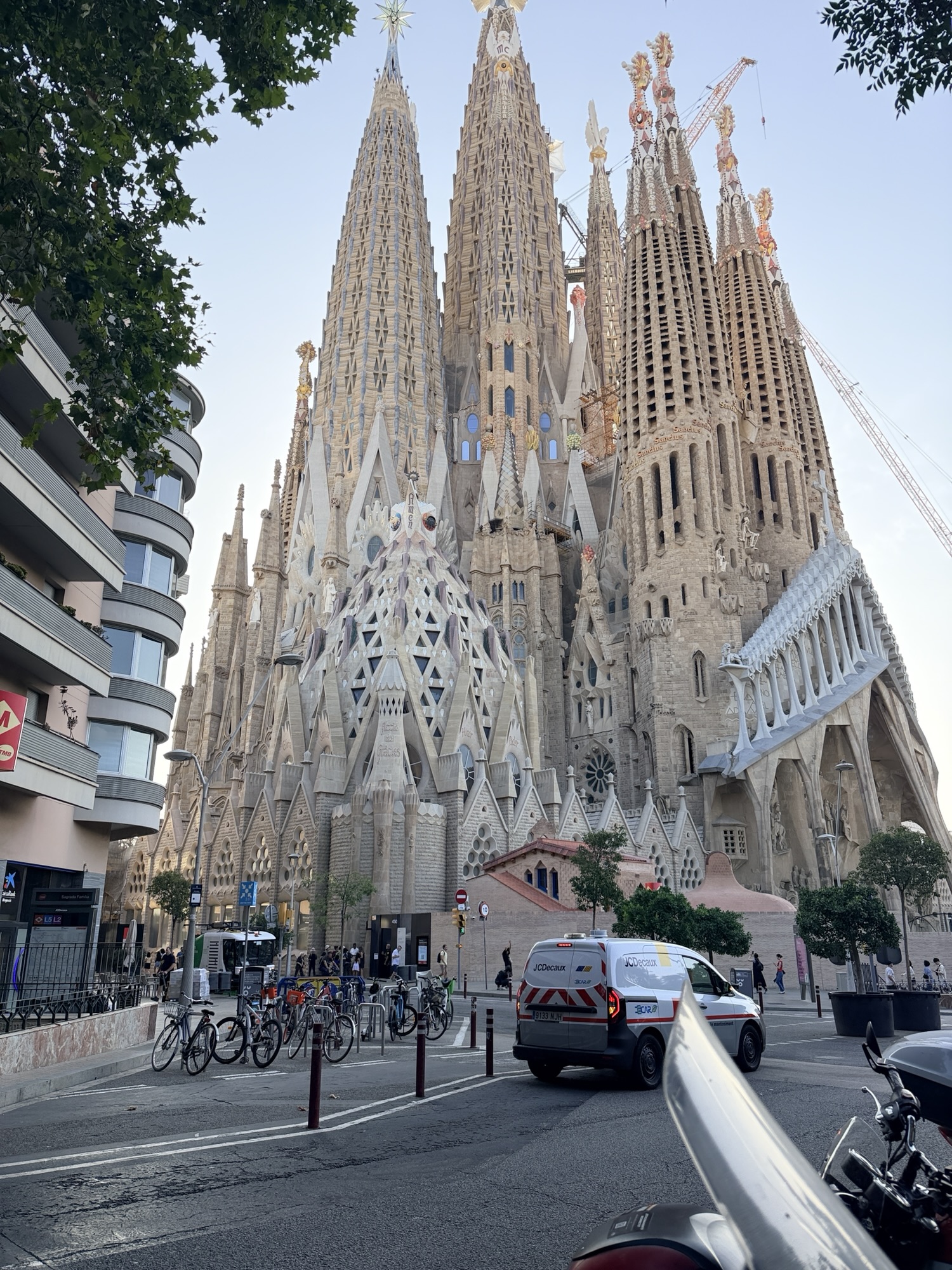
Not entirely sure what to write about in this post. The Sagrada was Gaudi’s final project but he wasn’t the first architect. The Sagrada had one criteria – all funds had to come from donations.
Early Years
Francisco de Paula del Villar was the first architect. Work started in 1882 and he was given a very strict limitation – do whatever he wants but funding had to come from donations – no outside funding, no wealthy benefactors, no external church funding. With such an unsure budget, all that got built was the foundation and crypt before he quit. Gaudí stepped in and agreed to the conditions. His idea was to build in sections and to build facades first, then floors and ceilings. By doing this, he felt that God was always present inside while they were building. Gaudi set to work only a year after Villar walked away – 1883.
Gaudí rarely did anything in a conventional way. Rather than relying solely on traditional drawings and calculations, he often worked with physical models—including structures made from chains and weighted cords hung upside down. Gravity naturally pulled the chains into the most efficient curves for carrying the loads; when the model was inverted, those curves became the arches and columns of the finished design. By adjusting the placement and weight of the chains, Gaudí could experiment with how forces would travel through the structure and determine the ideal form for supporting it.
The Sagrada was no exception. The immense towers (the tallest measures 172.5 meters – which is important) all are inverted curves. Nothing in the Sagrada has a straight line – everything is at an angle that Gaudi designed to mimic nature – nature doesn’t have straight lines so why should the Sagrada. So where did the 172.5 meters come from?
Gaudi believed that God created everything in nature so it must be perfect. His idea was that the central Tower of Jesus could not be taller than Montjuïc (a nearby mountain) because nothing man makes can surpass the work of God.
Gaudi created plaster moulds of every aspect of the Sagrada. The typical design of a basilica at the time was to have a very plain outside and very detailed and ornate interior. Of course Gaudi had to be different. He designed the outside to be just as ornate as the inside. His belief is that if this basilica was built from donations by the people, the. The basilica should be for the people to view and behold what they paid for.


Facades
There are two main facades – the Nativity Facade; and the Passion Facade. Gaudi was fortunate enough to complete the birth facade and plan out the rest before his untimely death. In 1925, Gaudi was struck by a streetcar. While he was the most famous person in Barcelona, no one knew who he was when he was struck so he lay dying in the streets before a bystander came over (Gaudi looked homeless so no one recognized him – overgrown beard, regular clothes; nothing that set him apart).
They eventually took him to the poor man’s hospital where he lay for another few days dying in a hospital bed with very little care. It was only when his apprentices and fellow workers went looking, did they find him. Once the staff knew who he was, he was given the best care possible but it was too late. He succumbed to his injuries and passed away. He now lays in a tomb in the crypt (which was the only finish room of the Sagrada at the time.
Gaudi was sure to include nature in every aspect of the Nativity facade – trees, fruit, animals – life. Its beautifully flowing designs are intricate and tell the story of Jesus’ birth and life. Two massive turtles are the anchor points of the pillars that divide the facade into 3 – Portal of Hope: dedicated to Joseph, his flight into Egypt and the Massacre of the Innocents; Portal of Charity:dedicated to Jesus. This is the large central section, with the Nativity, the Adoration of the Shepherds, and the Adoration of the Magi; Portal of Faith: dedicated to Mary. It includes scenes such as the Presentation of Jesus at the Temple and Jesus preaching in the Temple.
With the Passion facade completed, work now turned to the other sides in 1950’s. A local sculptor was hired in 1985 to create the Passion Facade. This stands as a harsh, stark comparison to the Nativity facade. Hard lines, dramatic scenes, and imposing figures all dominate the facade creating an intentional anguish and despair feeling.


The inside of the basilica is where Gaudi’s visionary truly shines. Every window is beautifully handcrafted stained glass masterpieces that not only reflect the facades outside – sunrise colours and blues and greens on the Nativity side, reds, yellows, browns on the Passion facade side – but create a godly glow on the inside of the church, filling it with every colour possible.


The columns inside appear to be straight up and down but are on a slight tilt upwards in order to provide the height needed to support the massive towers above but the ceiling doesn’t disappoint. Gaudi believed in light – every building he created lived up to his philosophy that natural light should flood the space. As the windows get bigger, the colours get lighter until they reach the ceiling at which point, become pure white. This white stained glass represents heaven with gold gilded decorations adorning the intricate designs and masterful centrepiece representing the light of God.


As you move towards the altar, you’re presented with 4 pinkish hued columns made of porphyry – an incredibly strong volcanic rock that could withstand the immense weight of the Tower of Jesus directly above it. Nearby columns were made from basalt (also volcanic). Basalt was used because of its incredible strength and endurance needed to hold up the smaller towers above.
The 4 center porphyry columns represent Matthew, Mark, Luke and John. Each adorned with glass domes facing down and in.
Each section of the stained glass contains names of cathedrals in the world, not in Latin but in Catalan. We found the Montreal one which wasn’t easy because some aren’t named for their English names but of the patron saints.
The last part of the tour was even more interesting. We got to ride an elevator up one of the bell towers and look out on the city and the massive roof top. From a distance, the spire have colourful tops; up close, it’s all mosaic tile formed into shapes of fruit – on the Nativity Facade side the fruit is of spring and summer varieties where the Passion Facade side is fall and winter varieties.


What comes up, must come down…. the stairs down were fine until the last 50m or so, then it became a tight, small spiral staircase.

Here’s some other pictures I took of the Sagrada.


Justyn Perry
Justyn shares first-hand travel stories, honest recommendations and the practical details that make a journey easier to plan.
More about Billy Goat HikerKeep exploring


The next story, straight to your inbox
Food finds, honest stays, memorable activities and practical travel notes from journeys near and far.
One email when a new story is published. Unsubscribe anytime.