After leaving Barcelona, we were on our way via flight to Bergamo, Italy then train to Tirano for an overnight. The next morning we caught the Bernina Express to Chur, Switzerland.
Tirano
Our train ride from Bergamo to Tirano was an interesting one. There’s a direct bus from the airport to Bergamo train station (which is going through a HUGE renovation). We caught the train into Milano Centrale and had 30 minutes to change trains to Tirano. We thought (incorrectly) that we had enough time to find a bottle of wine, snacks and maybe a sandwich. Turns out, Milano Centrale is a massive train station and navigating finding a store that we could grab our items was more difficult than we anticipated. We eventually found sandwiches but ran out of time for the other items.
We ended up getting to our train with 5 minutes to spare and off we went to Tirano (with a full train). We debated staying over night or two in Lake Como but after seeing the price per night, decided Tirano would do just fine. 
As we sped by Lake Como and spent around an hour tracing its coastline; getting snippets of brilliant blue water against lush hills and burnt sienna rooftops. Of course I didn’t snap any pictures of the lake.


Each stop along the way emptied out the train; and little by little, we arrived at Tirano with very few people getting off. Tirano was not yet end of the line we were on. When we stepped off the train, we were greeted a heat – surprising to think that it was this warm in the Alps.
A short walk from the train to our Airbnb which was a newer apartment style building. It was comfortable for the single night we were there for. We ditched our luggage and wandered the “old” part of town – a medieval area that seemed to be centered around a church. Nothing ornate on the outside but on the inside – a beautiful medieval interior with marble and granite.


The rest of the town held an old world charm – small streets, tall buildings, and a watchtower- probably originally built to look down the valley for possible invaders.


As we wandered, we found a cafe / bar ave enjoyed negronis which came with a wonderful tagliare (a small sampling of different foods – this one was meat, cheese, crackers, pickles, pizza, olives, and chips and salsa). We wandered some more and found another place abs had white wine – the server was great. She helped us learn a new way to ask for a glass of wine that was more casual and informal; roughly translated – a chalice of wine. Who doesn’t want a chalice of wine. We were surprised with more nibbles – more pizza – two meat ones and two squash/veg ones.
Dinner that night was amazing. It was our first big meal this trip – Barcelona was great food but mainly consisted of Tapas, so this was our first chance at a full meal. I had a traditional black pasta in a creamy cheese sauce and what tasted like mushrooms for my first plate (Primi) and a traditional meat on a stick with grilled vegetables for my second plate (Secondi). We had local wine – both white and red – both great and both complimenting the food.

We stumbled home, both tired from a long travel day but not before taking in the cool alp air.


Tirano feels like a place that deserves more than one night. There’s lots to see in the town as well as the area. The food is spectacular, the people are from all over and friendly, and the town seems to ebb and flow as the tourists arrive for the Bernina and leave on the Bernina (or to Milan).
Bernina Express
Where to start…
The Bernina Express has two routes – the Tirano to Chur over the Alps, and the Albula which goes through St Moritz and the Abula tunnel. Our route was over the Alps.
Our day started in Tirano – relatively early – early enough that cafes weren’t quite open or the ones that were, were just starting to see their first customers of the day. We had to make one stop at 7:30 – the local Coop to get a bottle of wine to enjoy on the train. Next stop was a cafe to get an espresso and two chocolate pastries – our priorities were what they were.
We boarded the Bernina at the train station and then proceeded up the valley. The train wound its way through the town itself first, then started to climb and within 5-10 minutes, we had left Italy behind and were crossing into Switzerland. When the railway was built, the border had a special significance for the trains – there was a hydroelectric dam that produced all the power for the trains.
The trains didn’t run on the typical 11,000V AC like the other trains of the time; it ran on 1,000V DC. The Bernina was opened in 1908-1910 and at the time, DC traction was a tried and true technology; why change what isn’t broken. The Albula line runs on the newer 11,000V AC technology. When the Bernina was absorbed into the RhB network, they decided it would be too expensive to convert it so they left the lines at 1,000V but converted the locomotives to run on both.
Now that the trains are powered and on the move, we continued up the valley. The Bernina is an interesting feature of engineering; the grade is the steepest at 7% without using a cogwheel or pinion system. It’s slow at a max speed of 80km/hr in flat areas, although much slower the pass.
Once up over the first tight valley, it opens up and you’re presented with multiple small towns, each bustling with activity.


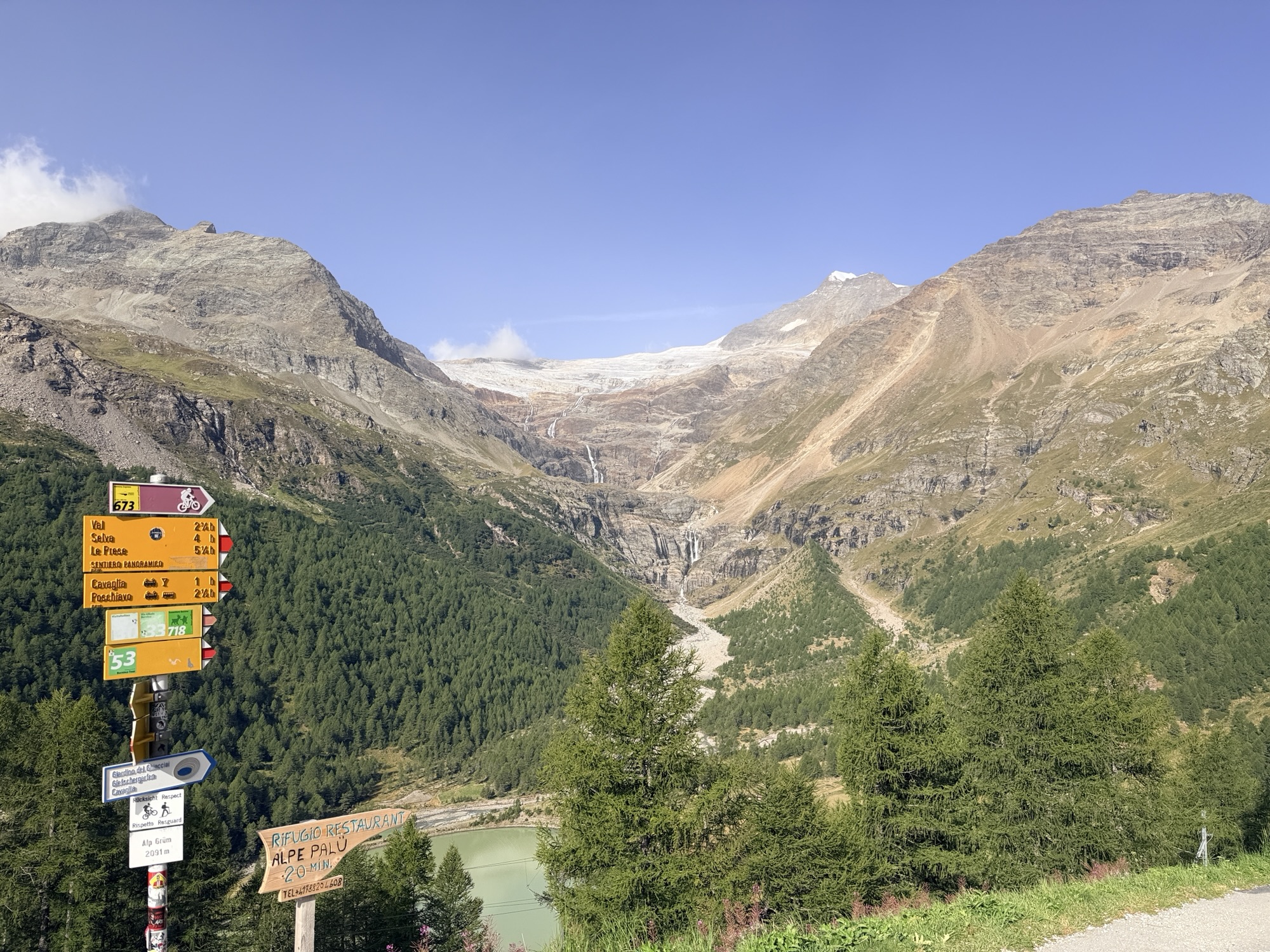
At its peak, the Bernina reaches an elevation of 2,253m or 7,392′. It is one of 4 railways in the world to reach a UNESCO status – one being in India, the other is in Austria and a newly minted one is in Iran. The full Bernina railway crosses 196 bridges and through 55 tunnels. One such tunnel is the Palü helical tunnel – in order to lose/gain elevation in a short span, the train circles back on itself and loops around with tight 180 degree curves and galleries. This valley often gets cold winter weather. Every March, the children of the Alpine villages will walk through the fields with cowbells and other instruments, singing away the cold to usher in spring.
On the other side, it needs to gain/lose elevation just as quick so they built circular bridges to handle the change in elevation – the Brusio Circular Viaduct.
The Morteratsch Glacier at the top is one of the largest in the eastern alps. The glacier melt is split between the watershed to the south – Poschiavino → Adda → Po → Adriatic Sea; and to tge north – Inn River → Danube → Black Sea.
Almost through the pass and down to the flats, we were presented with a large amount of castles (well, what used to be castles). It is the largest concentration of castles in Europe – the Domleschg valley. The Domleschg Castle Trail alone highlights 15 castles, palaces and ruins, a reminder that this valley was historically an important north–south route through the Alps.
Through the castles and the flats, Chur was within sight.
Chur
We arrived in Chur at roughly 1:00pm. Hotel Surselva was a 15 minute walk from the station through old town. It was again, another hot day. Turns out, Chur is the hottest town in Switzerland (temperature wise). We definitely felt it and hoped our hotel had air conditioning. Turns out, it had “AC” – ice packs in a swamp cooler type fan. It worked but when the water became warm, the humidity rose significantly. Luckily the nights cooled off so we could open all the windows.


Chur was a very friendly town; everyone said good morning or good day, shop owners were appreciative, and the servers were helpful when you didn’t pronounce something correctly. We tried to sample all the traditional local dishes, wine and spirits we could. Wienerschnitzel, capuns, bünderfleisch, alpine cheese – all staples. Particularly interesting was the cheeses, alpine air cured bünderfleisch, and capuns (Swiss chard wrapped spatzle with cheese and bacon).


Food aside, we did enjoy our day in the alpines. On Friday, we took the gondola up (almost straight up) and visited the small ski hill up top – Brambrüesch. It was a mix of cloudy and sun, rain and wind but felt great after cooking in Barcelona. We walked around and settled in at a small local restaurant to take shelter from the rain. More schnitzel and beer. We also consumed mulled wine and homemade Kuchen – all very delicious.


Down the gondola we went and made it home in time for a refresh before dinner. On our way to dinner, we stopped at a few places and enjoyed wine under an umbrella while it rained; then when it cleared off, walked through old town to another place for another drink – grappa for me, aperol spritz for Curtis.
Then onto dinner at a traditional Swiss restaurant for capuns, schnitzel, liquors, and more local wine. There was a local couple at the table beside us that we struck up a conversation with. They live in Zürich and have a weekend house in the mountains, so they were there to get away from the big city. We talked for about an hour or hour and a half before they left on the bus back to their alp house.
We finished desert and went back to our hotel where we packed, got ready for our train on Saturday to Zürich.
Zürich was a quick stop – 3 hours. We made a loop of old town and sat some neat buildings, had coffee, lunch (bratwurst), a panache (lemonade and beer), and bought some small chocolates from a local chocolate shop (they melted in the bag in the train so we had to eat them quickly).


With our stop completed, we boarded the train to Milan for the next part of our journey.

Justyn Perry
Justyn shares first-hand travel stories, honest recommendations and the practical details that make a journey easier to plan.
More about Billy Goat HikerKeep exploring


The next story, straight to your inbox
Food finds, honest stays, memorable activities and practical travel notes from journeys near and far.
One email when a new story is published. Unsubscribe anytime.