We arrived in Girona around nine at night after a long travel day, and by that point we wanted very little from the city. Food. Wine. Sleep. Everything else could wait until morning.
The walk from the train station to our hotel turned out to be our first introduction to Girona, even if we were too tired to fully appreciate it at the time.
The station itself was massive, buried several stories underground in concrete, harsh lines and artificial light. When we finally surfaced, Girona felt modern. The buildings looked old by Canadian standards, perhaps a hundred years or so, but they were unmistakably part of a newer city.
Then we kept walking.
The buildings gradually aged. The streets changed. By the time we reached the river, it felt as though we had reached a dividing line between what Girona is and what Girona was.
We crossed the bridge.
And suddenly there was stone.
We had been able to see the tower of the Basilica of Sant Feliu from much farther away, but until then we had mostly been concentrating on getting ourselves and our luggage through town. Up close, it was enormous. Imposing. Almost severe.
It did not initially feel like a church tower to me. It felt defensive.
The lines were hard and deliberate. There was very little softness to it. It looked less like something designed to welcome people inside and more like something constructed to tell everyone outside to stay away.
Then we saw the cathedral illuminated above the old town.
It seemed to lord over everything below it.
At night, Girona’s old city did not feel quaint. It felt medieval in the truest sense of the word: imposing, defensive and slightly intimidating.
We checked in, found a nearby tavern, ordered tapas and wine, and decided the rest of Girona could wait until morning.
A Medieval City
In daylight, the old town softened, but it never stopped feeling like a fortress.
As we wandered around Sant Feliu and climbed toward the cathedral near the Arab Baths, we both kept joking that it felt entirely reasonable that a knight might come around the next corner.
The basilica tower that had seemed to say don’t come here the night before now felt more like I’m here, and I’m watching you.
Still imposing. Just less threatening.
It was around here that Girona separated itself from nearly every other European city we had visited during the trip.
Tirano had felt like a quiet mountain town, its architecture shaped by the Alps around it. Florence was romantic and unmistakably Renaissance. Naples almost felt foreign to us compared with the Italy we thought we understood. Cosenza felt forgotten, with glimpses of its medieval past still visible beneath years of neglect. Catania was a city rebuilt again and again. Palermo carried thousands of years of cultures layered over one another, sometimes feeling almost Arab before suddenly reminding you that you were still very much in Italy.
Girona felt medieval.
Not medieval because there happened to be an old church or a surviving wall somewhere in town.
The entire old city felt built around defence.
Massive stone walls. Towers. Limited entrances. Narrow streets. Buildings crowded against one another. Staircases adapting to the hillside. A cathedral dominating everything from above.
We had spent weeks walking cobblestone streets and squeezing through narrow European lanes, but Girona was different.
Girona felt like a fortress.
And strangely, that made it feel incredibly safe.


Inside the Walls
There seemed to be only a few obvious ways into the true old town, which was probably once exactly the point.
The walls enclosed you. Towers watched over you. Streets twisted away from the entrances.
Centuries ago, those things existed to protect the people inside from whatever was approaching from beyond the walls.
Today, the same architecture creates an unexpected feeling of being held.
Girona felt like it was giving us a warm embrace.
One of the places that stayed with me most was the Jardins dels Alemanys.
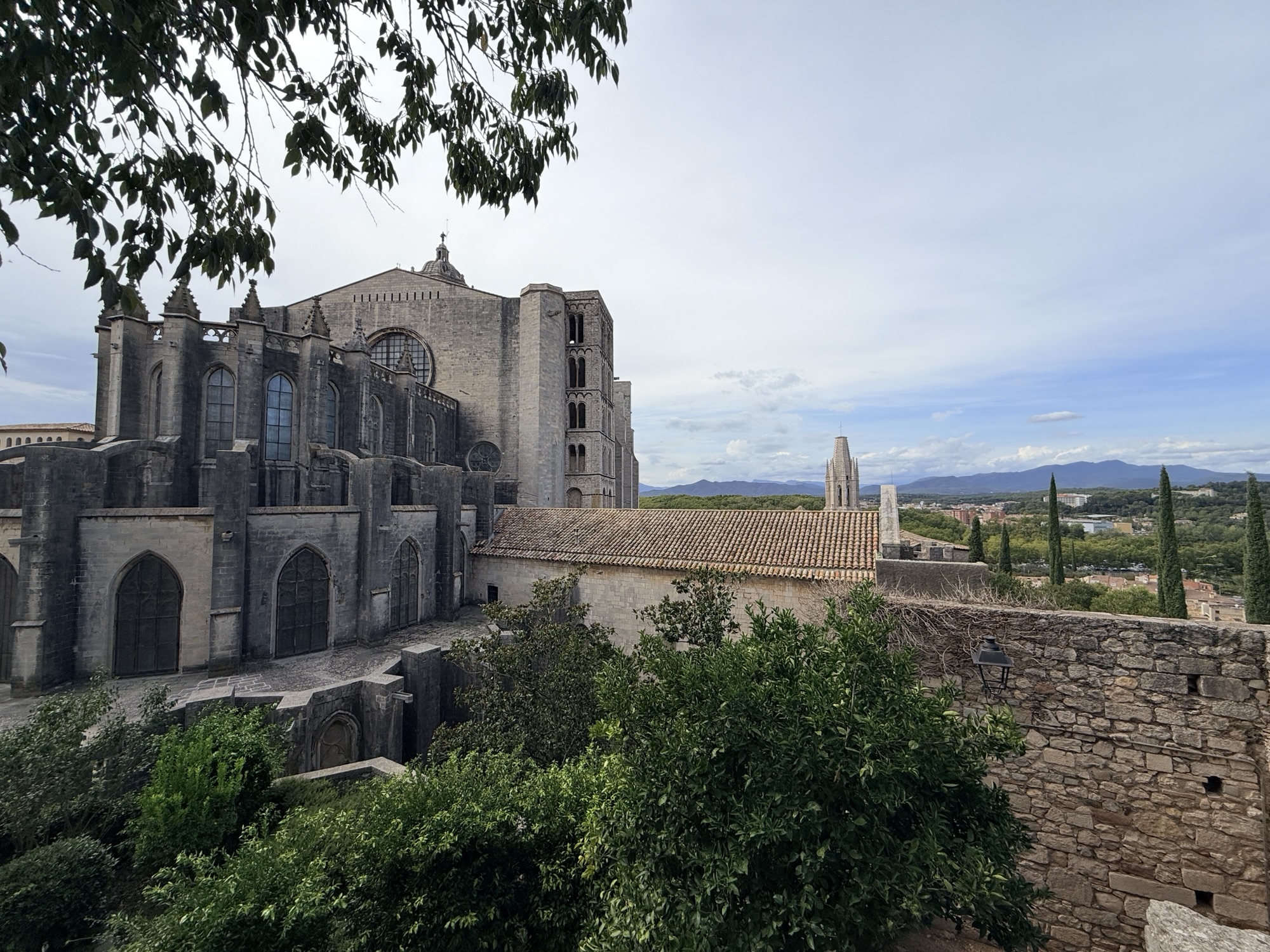
Walking through the gardens almost felt like seeing the fortress from outside itself. Trees and greenery softened the heavy stone walls. Stairs disappeared between old structures. The cathedral and towers rose above everything while pathways wound through what had once been defensive spaces.
It was one of the clearest examples of what Girona had become.
Stone that had once been about survival was now surrounded by gardens.
The other place that stayed with us was the Jewish Quarter.
The streets there felt strangely organic despite being entirely man-made. They twisted with the hillside instead of fighting against it. A road might suddenly become stairs. Another would slope sharply downward. A narrow passage would open unexpectedly into a small square.
Trees seemed to grow directly out of stone and concrete.
Nothing felt perfectly planned, and that was exactly why it worked.
The city seemed to have adapted itself to the land rather than forcing the land to adapt to the city.
Walking the Walls
Walking Girona’s city walls changed our perspective again.
From below, the walls were impressive.
From above, they suddenly made sense.
Standing on them gave us the strange sensation of being on guard. You looked across the rooftops and understood what those walls had once been protecting.
Turn the other direction and the countryside opened in front of us: green hills, forests and a landscape that made it incredibly easy to mentally strip away the modern world.
For a moment, it was possible to imagine medieval Girona beneath us.
Smoke rising from chimneys.
The sound of animals somewhere beyond the walls.
Wagons and carriages rolling across uneven stone streets.
The mixed smell of barnyard, bread baking and wood smoke.
Incense drifting from open cathedral windows.
Chants or choir music floating across the rooftops.
The walls were not simply somewhere to get a better photograph of Girona.
They reminded us why Girona existed in the form it did.
Below are pictures from the basilica – equally as old as the cathedral.


The Cathedral
The cathedral was perhaps the most powerful expression of that medieval feeling.
From outside, it almost looked like a giant stone box. A tomb perched above the city.
Inside, the scale was overwhelming.
The vaulted ceiling rose so high that the architecture somehow felt oppressive and submissive at the same time.
It made us feel small.
Not insignificant exactly, but humbled.
Very soft choir music was playing somewhere inside while we visited. It barely filled the cathedral, which somehow made it more effective. The voices seemed to disappear into the enormous stone space above us before returning as a faint echo.
It was hauntingly beautiful.
And perhaps more than anywhere else we visited in Girona, standing inside the cathedral made the medieval city feel real.


Two Gironas
During the day, Girona’s old town could become busy.
Large tour groups would appear almost in waves, walk through the major streets, visit the cathedral and other landmarks, and then disappear again.
For a while the city would feel full.
Then suddenly it would be quiet.
We were never quite sure whether old Girona belonged more to tourists or locals.
In the daytime, tourism clearly shaped much of it.
At night, the city changed.
The tour groups vanished. Families appeared in the squares. Children played while parents sat nearby with drinks. Locals gathered around tables. Conversations blended together into a gentle background hum.
That was the Girona we liked most.
Two nights we returned to the same tavern near us.
We ordered wine, played dice, got up occasionally to choose another pintxo, returned to the table, played more dice and watched the square around us.
Kids ran through the plaza.
People laughed.
Glasses clinked.
Nobody seemed to be in a hurry.
After weeks of sightseeing, moving, crowds and constantly trying to experience one more thing, Girona gave us something we did not realize we needed.
We could just exist.


Pintxos, Wine and Vermouth
Girona also changed the rhythm of how we ate.
By the end of Italy we had settled into a fairly predictable schedule: a light breakfast, lunch sometime around two, and then a large dinner around eight.
Girona replaced meals with opportunities.
A glass of wine and pintxos at noon.
Another stop around three.
Something else at five.
Maybe another drink and food at nine.
It suited us perfectly.
Although, somehow, virtually everything seemed to involve bread.
We ate Catalan food, drank good wine and returned to vermouth, something we had first discovered in Barcelona roughly forty days earlier at the beginning of the trip.
There was something satisfying about ending the journey with something that had helped start it.
A Modern City Inside a Medieval One
Girona was not frozen in history.
There were cafés, restaurants, students, families and an astonishing number of cyclists.
Seriously. Cyclists everywhere.
Bike shops everywhere.
After spending weeks learning how to dodge cars, scooters and pedestrians, apparently our final challenge was learning how to dodge bicycles.
It became slightly annoying.
We also happened to arrive during Oktoberfest.
Celebrating Oktoberfest in Spain was not something we had planned, but it was a fun coincidence. We had beer, bratwurst and watched a noticeably younger crowd enjoying themselves before deciding that our preferred evening still involved old Girona, tapas and wine.
At nearly forty, even I felt old there.
Girona was also an obvious filming location for Game of Thrones, and walking through the city made it easy to understand why HBO chose it.
The connection worked because Girona did not need much pretending.
The fictional history and the real history seemed to mirror one another: one invented, one very real.
The River Between Two Cities
The river remained a dividing line throughout our stay.
On one side was a newer Girona.
On the other was the old fortified city.
The Eiffel Bridge was interesting and immediately recognizable, but it was the stone bridges that stood out more to us.
They felt less decorative and more necessary.
The river divided.
The bridges connected.
Crossing them felt almost like moving between two different versions of Girona.

The Perfect End Cap
We had barely researched Girona before deciding to stay there.
It was almost a random choice.
And it turned out to be exactly what we needed at the end of the trip.
We were tired of crowds.
Tired of fighting through busy streets.
Tired of cobblestone.
Tired of feeling like every day needed another major attraction attached to it.
Girona was quiet without being sleepy.
Calm without being boring.
There were things to see, but the city never seemed to demand that we see them.
It allowed us to slow down.
Then, on our final evening, the calm abruptly ended.
We received a civil protection alert warning of a major rain event approaching the region.
What followed felt like a miniature hurricane.
Trains were cancelled. Buses were cancelled. Routes toward Barcelona disappeared one after another, and instead of spending our final night lingering over wine in Girona, we spent much of it trying to figure out whether we could actually reach the airport the following morning.
Eventually we booked a private driver.
It was expensive.
It was also one of the better decisions we made.
The trains still were not running when we needed to leave, and once we reached Barcelona Airport the scale of the disruption became obvious. People were sleeping throughout the terminal. Cancelled and delayed flights filled the departure boards. The airport was chaos.
After seeing the flooding around Barcelona, we were extremely glad we had spent those final days in Girona.
The storm did not taint our experience of the city.
If anything, it made those quiet evenings sitting in the square feel even more valuable.
Fortified by Battle, Softened by Peace
I do not know if we will return to Girona.
There is simply too much of Europe left for us to see.
But Girona changed what we want to see next.
We want more medieval towns.
More castles.
More small cities.
More places where history is not confined to a museum or a single monument but still dictates the shape of the streets around you.
Girona felt like a town fortified by sieges and battles and eventually softened by peace.
The defensive walls are still there.
The towers still watch over the city.
The cathedral still dominates the skyline.
But gardens now grow against those walls.
Restaurants fill buildings that once stood inside a defensive city.
Families gather in the squares.
Children play beneath stone towers.
Visitors wander through gates that were once designed to keep outsiders away.
Somewhere along the way, Girona stopped being a city built to protect itself from the outside world.
And finally learned to let the outside in.

Justyn Perry
Justyn shares first-hand travel stories, honest recommendations and the practical details that make a journey easier to plan.
More about Billy Goat HikerKeep exploring


The next story, straight to your inbox
Food finds, honest stays, memorable activities and practical travel notes from journeys near and far.
One email when a new story is published. Unsubscribe anytime.