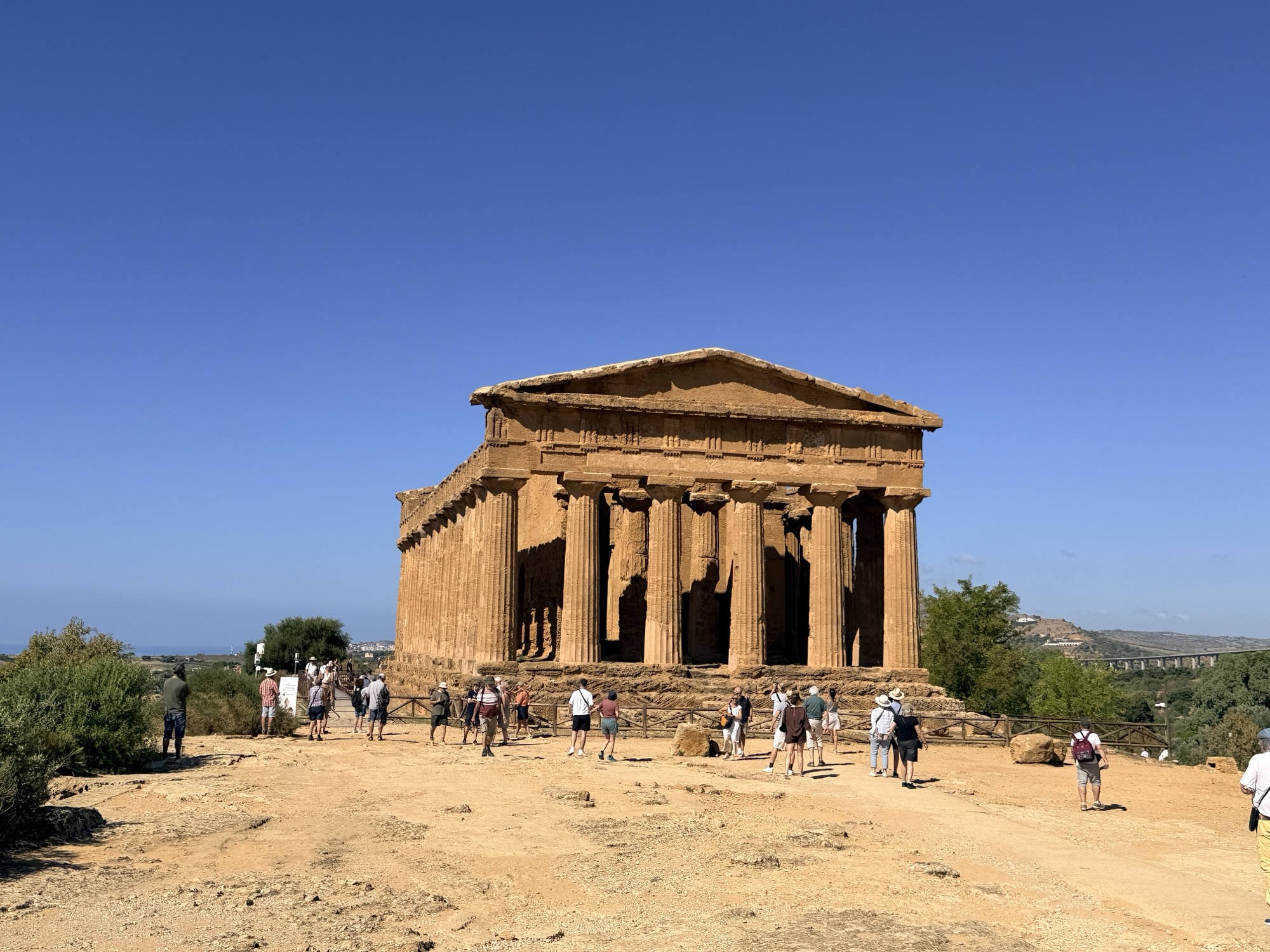
Four years ago, we visited the Valley of the Temples.
Technically.
There had been a miscommunication somewhere along the way and we ended up with about an hour to see the entire site. It was hot, Sicily was still unusually quiet because of the pandemic, and we basically had to run from Porta V to Porta Giunone and back.
What I remember most from that first visit was being awestruck.
Even without really knowing what we were looking at, there was something almost unbelievable about seeing these enormous Greek temples still standing after more than two thousand years. Some were remarkably intact. Others were reduced to columns and huge piles of stone, but even those felt monumental.
The problem was that we didn’t really have time to understand any of it.
We had no guide and no audio tour. There were information panels, but stopping long enough to read them meant sacrificing something else further along the route. So we looked, took pictures, marvelled at the scale of it all and kept moving.
It was impressive.
But in a lot of ways, it was all Greek to us.
This time, we came back to actually understand the Greek.
Akragas
Long before there was Agrigento, there was Akragas.
The Greek city was founded around 580 BCE by settlers from Gela and grew into one of the important cities of the Greek Mediterranean. By the fifth century BCE, its southern ridge was lined with enormous Doric temples.
That history meant more to us this time because over the last few years we’ve also visited Crete and Naxos, and one thing we are beginning to understand about the ancient Greeks is that very little seems accidental.
Where something was built mattered.
What it overlooked mattered.
How you approached it mattered.
The landscape around it mattered.
And Agrigento may be one of the best examples we have seen.
The temples sit along a long ridge above the coastal plain, with fertile land below and the Mediterranean beyond it. The city had agricultural resources, defensive advantages and access toward the sea, but standing there, it also feels like something more than practicality.
It feels like presentation.
Nature had already created something grandiose here — rolling land, sea, stone and sky — and the Greeks answered by placing enormous hand-built temples along the ridge.
Almost as if to say:
Yes. We can build something beautiful too.


Starting Again
This time we started at the Temple of Juno and worked our way downhill toward Porta V.
We spent about three hours instead of one.
It was still hot, but after five weeks travelling through southern Europe, the heat barely registered anymore. There was a slight breeze and, most importantly, we weren’t in a hurry.
That changed everything.
Instead of trying to see how much we could physically cover, we could stop. Look around. Listen. Think about what had been there before us.
The Temple of Juno sits near the highest point of the ridge, and whether the ancient attribution to Hera or Juno is ultimately correct or not, its position feels deliberate. Even today it announces itself from a distance.


Nearby, the remains of the altar also helped us understand something we hadn’t appreciated four years earlier: worship wasn’t necessarily centred inside the temple itself. Sacrifices and offerings could take place outside, while the temple functioned more as the dwelling place of the deity.
Suddenly the site began to feel less like a collection of buildings and more like a city where people actually did things.
Concordia
Then we reached the Temple of Concordia.
It is almost absurdly intact.
Standing beside it, my first thought was that they could do some light sweeping and reopen the place.
Compared with the Temple of Herakles further along the ridge, where only a line of columns survives, Concordia almost feels untouched.
Its survival is partly thanks to one of the very layers of history that fascinated us throughout the site. In late antiquity, the temple was converted into a Christian church, which helped preserve much of its structure.
Even the name “Concordia” is a later one. The original deity to whom the Greek temple was dedicated is not known with certainty.
That became another theme of the day.
We tend to look at ruins and imagine one civilization.
Greek.
Roman.
Christian.
But places like Agrigento were continually reused.
Walls became foundations. Temples became churches. Stone was repurposed. Burial places appeared where something else had existed before.
Generation after generation kept adapting the landscape to suit whatever life required next.
The Valley of the Temples isn’t one frozen moment in history.
It is layers.

(Christian burial spots carved from original Greek walls)


What Survives — and What Doesn’t
Further along, the Temple of Herakles looks entirely different.
Eight columns stand today, giving only a suggestion of the enormous structure that once occupied the site. It is believed to be the oldest of Agrigento’s major Doric temples.
And then you reach the Temple of Olympian Zeus.
This one is difficult to comprehend even in ruins.
It was built on an enormous scale and was intended to be one of the largest sacred buildings of the ancient Greek world.
Among its most extraordinary features were the Telamons — gigantic human figures incorporated into the architecture.
Seeing one immediately reminded us of Naxos.
There, enormous unfinished kouroi still lie where ancient sculptors abandoned them thousands of years ago. Here, the Telamons offered a different version of the same idea: humans rendered at a scale that makes the actual human standing beside them feel very small.
The Greeks clearly understood drama.


Nature Was Part of It Too
This time, we paid much more attention to what was growing around the temples.
Olive trees. Mediterranean herbs. Dry grasses.
Plants that would have provided food, oil, medicine, fuel and materials to the people living here.
Even the prickly pear cactus that now feels so completely Sicilian is a much later arrival from the Americas.
Four years ago, most of that was scenery.
This time, it felt like part of the story.
It also changed the way the temples themselves looked to us.
In Crete, particularly at reconstructed ancient sites, colour and decoration can make the human hand feel obvious. You see architecture saying very clearly: we built this.
Agrigento felt different.
The temples are made from the same warm stone tones as the ridge beneath them. Weathering has softened them further. Olive trees twist alongside them. Grass grows between fallen blocks.
We know the temples probably looked far more colourful in antiquity than they do today.
But what survives now feels as though it grew out of the hillside.
Instead of being plopped into the landscape, they belong to it.


 (massive hedges of rosemary)
(Massive prickly pear which was introduced many many many years later)
Understanding the Greek
That may have been the biggest difference between our two visits.
The first time, we stood at a distance and wondered.
This time, we could understand at least a little of the thinking behind what we were seeing.
Why this ridge.
Why these views.
Why these enormous dimensions.
Why the temples were arranged where they were.
Why an altar might sit outside.
Why later civilizations reused what came before instead of simply abandoning it.
And also how much we still don’t know.
Some of the familiar temple names are later attributions. In some cases, we simply do not know with certainty which deity was worshipped inside.
That uncertainty actually made the site more interesting.
We weren’t walking through a perfectly solved puzzle.
We were walking through the surviving pieces.


Seeing It Twice
By the time we reached Porta V, we felt like we had accomplished exactly what we came back to do.
We had learned about the past without killing ourselves trying to see every last thing.
The gardens were closed, so somehow the Valley of the Temples has now managed to keep one thing from us on both visits.
Maybe it wants a third chance.
But this time, we left satisfied.
Four years ago, we saw the Valley of the Temples.
This time, we experienced it.
We slowed down long enough to understand why the city was here, why the temples were placed where they were and how generations of people kept reshaping the same landscape.
And after Crete, Naxos and now Agrigento, we are starting to recognize something that once seemed completely foreign.
The first time, it was all Greek to us.
This time, we understood the Greek.
Second chances are definitely worth it.

Justyn Perry
Justyn shares first-hand travel stories, honest recommendations and the practical details that make a journey easier to plan.
More about Billy Goat HikerKeep exploring


The next story, straight to your inbox
Food finds, honest stays, memorable activities and practical travel notes from journeys near and far.
One email when a new story is published. Unsubscribe anytime.