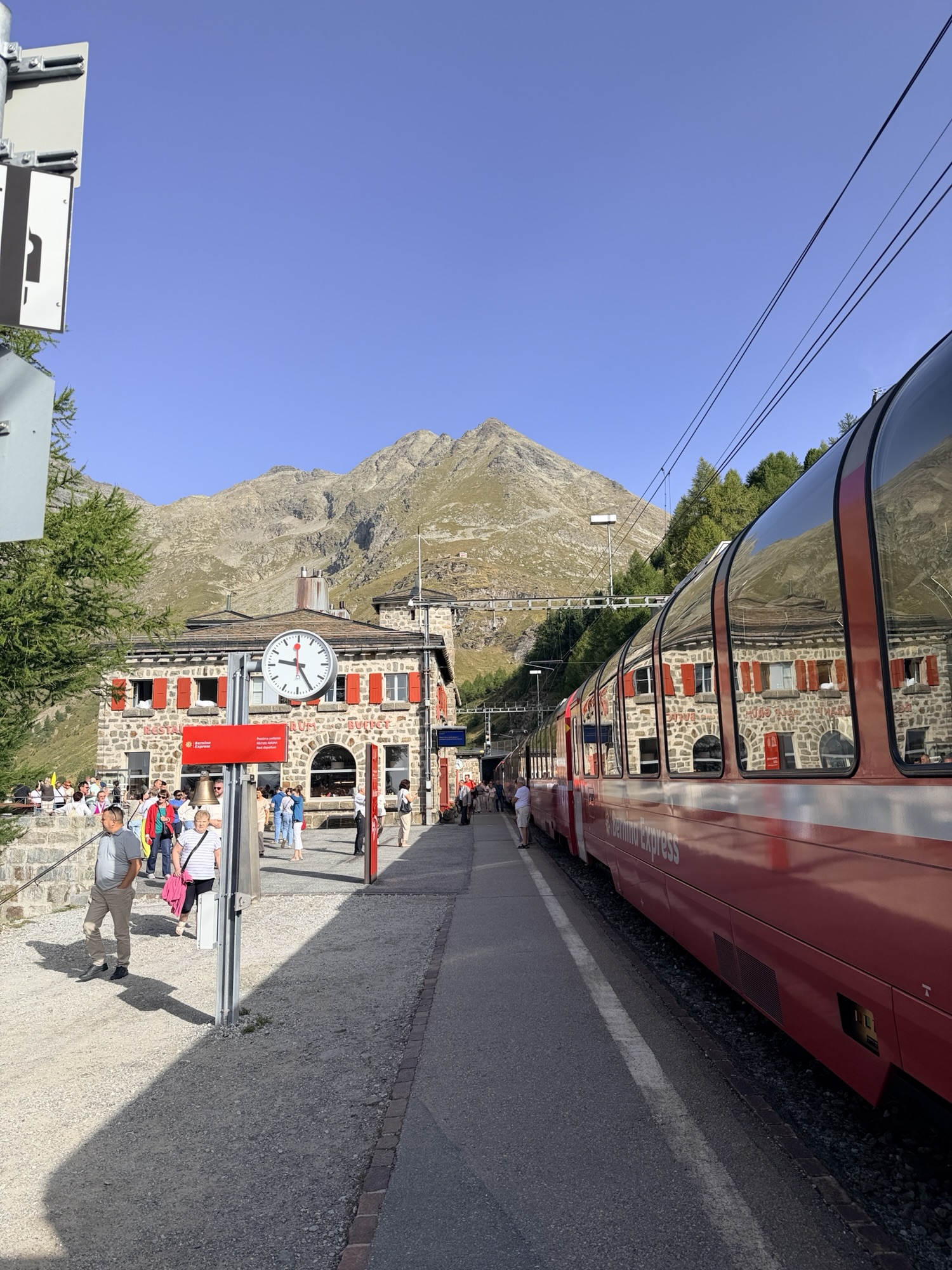
Before this trip, European train travel felt much more intimidating than it probably should have. We had taken a few trains in Europe before, but not enough to feel like we really understood the system. There always seemed to be another question. Which platform? Which carriage? Did we need a reservation? Could we just get on? Why did the departure board show a city we weren’t actually going to? And why did everyone else seem to know exactly what they were doing?
At the beginning, our solution was to be ridiculously early. We would arrive at the station with far too much time, stare at the departure board, check it again a few minutes later, wander toward what we thought might be the right platform, then second-guess ourselves and check everything again. We worried about carriage numbers, seat reservations and whether we were standing in the right place. Somehow getting onto a train felt like something that had to be carefully managed.
Then, somewhere along the way, it just clicked.
Figuring Out What Actually Matters
There wasn’t really one moment where we suddenly understood European train travel. It was more that the individual pieces slowly stopped feeling mysterious. We figured out how the carriage numbers worked. We learned which trains needed reservations and which ones we could simply hop onto. We stopped being confused when the final destination on the board wasn’t our destination, because we understood that our stop was just somewhere along that route.
More importantly, we stopped trying to understand the entire rail system every time we entered a station. We only needed to understand the next train.
That changed everything.
By the middle of the trip, our routine had become almost embarrassingly simple: arrive around thirty minutes before departure, find the train, find the platform, find the carriage and get on. That was basically it. By the end, we were joking that we were locals and not tourists anymore. No actual local would have believed us, but compared with the two people nervously staring at every departure board at the beginning of the trip, we had made considerable progress.
We had a monthly rail pass, and financially I think we probably broke even. There were days when it definitely saved us money and others where buying individual tickets might have worked out about the same. But by the end of the trip, I didn’t really care whether the math worked perfectly.
The value was freedom.
On the days when we were moving from one accommodation to another, we were more deliberate. Those were the days when we had all of our luggage with us, so we reserved seats whenever we could. If we didn’t have a reservation, we got to the station earlier so we had a better chance of getting seats and enough time to figure out where we needed to be.
Day trips were completely different. Usually we had one backpack between us and no real commitment to a particular train. We could decide where we wanted to go, head to the station and sometimes choose the actual train once we got there. If we wanted to stay somewhere longer, we stayed. If we were tired and wanted to leave early, we left. If we missed one train, there was usually another one.
That flexibility quietly changed how we travelled. We started prioritizing trains over almost everything else because they removed so much friction from the day. There was no security line, no liquid restrictions, no baggage check, no weighing luggage and no waiting around a carousel at the other end. Most of the time we left from somewhere near the centre of one city and arrived near the centre of another. We got on with our bag and got off with our bag.
Being carry-on only for the entire trip helped enormously. We watched people trying to manoeuvre giant suitcases through stations and up stairs and were repeatedly grateful that we didn’t have to do the same. Our bags were still heavy enough on travel days, but they were manageable. We could move between platforms quickly, deal with stairs and squeeze onto busy trains without needing half the platform to ourselves.
Three Countries, Three Different Rhythms
One of the things we didn’t really appreciate before the trip was how different train travel would feel from country to country.
Switzerland was exactly what you would expect Switzerland to be. You could practically set your watch to the trains. Connections were precise, schedules made sense and everything felt dependable. There was a calmness to travelling there because you very quickly trusted that the system was going to do what it said it would do.
The scenery didn’t hurt either.
Travelling through the Alps by train became one of those experiences where the transportation itself was part of what we had come to see. Flying over the Alps would have shown us the mountains, but the train let us travel through them. We followed rivers through green valleys, passed villages sitting below enormous peaks and watched the landscape change around us rather than underneath us.
Spain felt a little more relaxed. The trains were still mostly dependable and generally on time, but without the almost mechanical precision of Switzerland. It worked without feeling rigid. By the time we returned to Spain at the end of the trip, train travel felt completely natural. We walked into stations, checked the board and went where we needed to go without putting much thought into it.
Italy was different.
Italy taught us patience.
Platforms changed. Trains were delayed. Sometimes the platform wasn’t posted until five minutes before departure. Sometimes several hundred people would be standing around staring at the same board, waiting for the same information, and then suddenly everyone would pick up their bags and start moving at once.
Early in the trip, that would have stressed us out. Later, we realized that if several hundred Italians didn’t know what platform the train was leaving from either, there was absolutely no point in us panicking about it.
We also discovered that the crowd itself could become a form of information. If everyone suddenly grabbed their bags and headed somewhere else, there was a reasonable chance that something had changed and we should probably pay attention.
Italy didn’t exactly teach us to relax. It taught us how to stay alert without necessarily being stressed.
Busy platforms could still be ridiculous. There were moments when we felt like salmon swimming upstream while hundreds of people poured off a train and we were trying to get on. Eventually we figured out that sometimes the smartest thing to do was nothing. Wait twenty seconds. Let the crowd clear. Then get on without being run over by six rolling suitcases.
The Country Between the Destinations
The scenery became one of my favourite parts of travelling this way.
There were the obvious landscapes: the Alps, the Italian countryside, foothills, farmland and the different landscapes as we moved farther south. Sicily looked different again. But some of the views I remember best weren’t famous places at all.
We would disappear into a tunnel and emerge into something completely different. Sometimes there would be a valley on the other side that looked almost too perfect, with a river at the bottom and a village sitting halfway up the mountain. Other times there would be a town perched high above the tracks that we would see for only a few seconds before it disappeared behind us.
We didn’t know the names of most of those places. We didn’t stop there. They didn’t get added to an itinerary or become another thing we had to see. We simply saw them.
That became one of the unexpected things I loved about train travel. It filled in the blank spaces between the big destinations.
Flying makes those spaces disappear. You leave one city and then you are somewhere else. Everything between the airport at one end and the airport at the other becomes an abstract piece of geography far below you.
On the train, we watched one region gradually turn into another. Mountains softened into foothills. Cities gave way to farmland. Architecture changed. Vegetation changed. Villages looked different. Even the light sometimes seemed to shift.
It gave the trip a sense of continuity I don’t think we would have had if we had flown between the same places. Europe stopped feeling like a collection of isolated destinations and started feeling connected.
The longer train rides also became forced rest in the middle of what was otherwise a very active trip. We walked constantly, often from morning until night, so eventually sitting on a train for two or three hours became something we almost looked forward to. We could go through photos, talk about what we had seen, plan the next couple of days or simply stare out the window.
There was something nice about not having to turn every view into another attraction. Sometimes the only thing we had to do was sit there and watch the world go by.
The Stations Became Part of It Too
The stations themselves became part of the experience.
The big-city stations were massive, often in buildings that felt almost civic in scale. Huge halls, long rows of tracks, cafés, shops and departure boards constantly changing overhead. Thousands of people moved through them every day, commuting, meeting family, dragging luggage or heading somewhere new.
The big stations felt like movement.
The little stations felt like pauses.
Many of the smaller ones were just one little building running parallel to the tracks with one or two platforms. They could be almost completely quiet until a train appeared. Then for a minute or two, people got off, others got on, doors closed and everything went quiet again.
Not every train was enjoyable, of course. The two rides that genuinely annoyed us were both in Sicily: Palermo to Cefalù and Palermo to the Palermo airport. They were packed. People were standing, people were sitting on the floor, bags were everywhere and moving through the carriage became an obstacle course of legs, luggage and bodies.
Considering how many trains we took over the course of the trip, though, having only a couple that we really disliked seems like a pretty good record.
There were disruptions too.
At one point we got caught in a train strike and had three trains cancelled. Early in the trip that probably would have felt like a disaster. By then, our response was essentially to go to the local pub, have a few drinks and wait until a train eventually showed up. It was inconvenient, but it was also weirdly fun.
Another day, heavy rain delayed our train by about two hours. We scrambled, changed plans and ended up taking a ferry instead.
That became part of the whole lesson. A delayed train was just a delayed train. A cancelled train meant finding another one. A platform change meant walking to another platform. A strike might mean having a drink. Sometimes a train delay meant taking a ferry.
It stopped being about executing the perfect itinerary and became more about being flexible enough to keep moving.
When Transportation Became Part of the Adventure
By the end of the trip, trains were still the easiest way for us to get around, but they had become more than that.
At the beginning, I think we saw the train as transportation that got us to the trip. The interesting part was supposed to happen once we arrived somewhere.
That changed.
The train rides gave us the Alps from the inside rather than from above. They showed us farmland, villages and towns we never would have known existed. They gave us time to sit after long days of walking and let the previous few days settle a little before we rushed into the next place. They gave us moments of chaos, moments of complete calm and occasionally a reason to sit in a pub waiting for Italy to sort itself out.
They also gave us freedom. With the rail pass, we weren’t constantly calculating whether a day trip was worth the extra ticket or whether we should leave at exactly 3:12 because that was the train we had booked. We could just go. That convenience probably mattered more than whatever money we did or didn’t save.
By the final weeks, walking into a station felt no more intimidating than walking into an airport back home. Actually, it usually felt easier. Find the board. Find the train. Find the platform. Get on.
It’s funny how something that caused so much anxiety at the beginning became so ordinary by the end.
If I could go back to the start of the trip and tell myself one thing, it would probably be this: don’t stress the trains or finding the platforms. It’s easier than you think.
And somewhere along the way, the thing we had worried about became one of the parts of the trip I’ll remember most.
The train stopped being the thing that got us to the adventure.
It became part of the adventure itself.

Justyn Perry
Justyn shares first-hand travel stories, honest recommendations and the practical details that make a journey easier to plan.
More about Billy Goat HikerKeep exploring


The next story, straight to your inbox
Food finds, honest stays, memorable activities and practical travel notes from journeys near and far.
One email when a new story is published. Unsubscribe anytime.