Certaldo – A Medieval Hill Town in Tuscany
After several days surrounded by the crowds, churches, museums and general sensory overload of Florence, we decided it was time for a change of pace.
Not that there is anything wrong with Florence. Florence is incredible. But after a while, there are only so many Renaissance masterpieces you can stare at in one day before your brain starts quietly begging for a glass of wine and a bench somewhere.
So we hopped on a train and headed for Certaldo, a small Tuscan town about an hour southwest of Florence.
Certaldo is actually split into two parts. Certaldo Basso is the modern town down in the valley, where the train station is located, while Certaldo Alto sits on the hill above it — a compact medieval village of brick buildings, narrow lanes, churches and old palaces.
And Certaldo Alto was exactly what we were looking for.
Getting Up to Certaldo Alto
From the train station, the walk through Certaldo Basso to the base of the old town is fairly short and straightforward.
Then you have a decision to make.
You can walk uphill.
Or you can take the funicular.
We took the funicular.
We have walked enough hills, towers, church domes, castle staircases and questionable European sidewalks on this trip that I feel absolutely no guilt admitting that.
The little funicular climbs directly from the lower town to Certaldo Alto and deposits you just inside the historic centre. It is a short ride, but it also makes the transition between the two halves of Certaldo rather dramatic.
One minute you’re standing in a fairly ordinary modern Tuscan town.
A few minutes later you’re surrounded by medieval brick walls.


Certaldo Alto
Certaldo Alto isn’t particularly large, which is part of its appeal.
This isn’t one of those places where you arrive with a list of fifteen attractions, six tickets and a carefully mapped route designed to make sure you don’t miss anything.
You just walk.
The historic town follows the long, narrow ridge of the hill, with Via Boccaccio forming its main spine. Unlike many Italian towns, Certaldo doesn’t really have one huge central piazza dominating the historic centre.
Instead, the town seems to unfold along the street itself.
Brick houses crowd together along the ridge, while smaller lanes disappear between them and drop steeply toward the valley below.
Some streets are paved in stone.
Others are cobbled.
Some pass beneath old brick arches or between walls that look as though they haven’t moved in several hundred years.

And because the town is so compact, there isn’t much danger of getting lost.
Even if you do, you’ll probably emerge somewhere interesting.
A Town Built in Brick
One of the first things we noticed about Certaldo Alto was the brick.
Lots and lots of brick.
Compared with Florence, where marble seems to have been applied to anything that stood still long enough, Certaldo has a much warmer and more rustic appearance.
The buildings are predominantly constructed from red brick, with stone appearing around doorways, foundations and old sections of wall.
Centuries of repairs have left their marks everywhere.
You can see changes in brickwork, blocked-up windows, newer stones worked into older walls and places where buildings have clearly been altered again and again as generations came and went.
It isn’t perfectly restored.
And that’s one of the things we liked about it.
Certaldo still feels lived in.
There are flower pots outside houses, laundry tucked away on balconies, small restaurants, little shops and olive trees growing almost directly against the medieval walls.
It feels less like an open-air museum and more like an old town that simply never stopped being a town.
Palazzo Pretorio
At the upper end of Certaldo Alto sits the Palazzo Pretorio, one of the most important historic buildings in town.
The building began as a fortified residence associated with the Alberti family, the feudal lords who once controlled the area.
When Certaldo later came under Florentine authority, the palace became the seat of the vicars who governed the surrounding territory on behalf of Florence.
Basically, this was where the local political and judicial machinery operated.
And judging by the old prison cells inside, medieval municipal government apparently wasn’t all paperwork.
The complex includes former courtrooms, administrative spaces, private chambers, a chapel and prison areas.
But the thing that immediately catches your attention is the decoration.
The Coats of Arms
The walls of Palazzo Pretorio are covered with coats of arms representing the families of the different officials who served here.
Some are painted directly onto the walls.
Others were created in carved or glazed terracotta.
They range from relatively simple heraldic designs to elaborate shields surrounded by figures and decorative borders.

Many of them include inscriptions recording the official’s name and term of office, essentially turning the walls into a visual record of generations of Florentine administration.
There is something fascinating about seeing them all together.
Today we might put someone’s name on a plaque in a government building.
Apparently in medieval Tuscany you had your family crest painted twelve feet wide across the wall.
Much better branding.
The Frescoes
Palazzo Pretorio also contains a collection of medieval and Renaissance frescoes.
Some are remarkably well preserved.
Others survive only in fragments.
But that actually makes them more interesting.
They haven’t been removed, cleaned to perfection and lined up beneath museum lighting. They remain on the walls of the buildings where people saw them hundreds of years ago.
In several places, paintings from different periods overlap one another, while old coats of arms and inscriptions fill whatever space was available.
You can almost read the history of the building through its walls.
One fresco we saw showed a large heraldic shield beside a scene containing figures and symbolic imagery, while the upper portion of the wall was lined with still more family arms.
There is no attempt to make everything look new.
Cracks remain.
Colours have faded.
Sections have disappeared entirely.
And somehow that makes the surviving portions feel even older.
Giovanni Boccaccio
Certaldo’s most famous resident was Giovanni Boccaccio, one of the major figures of medieval Italian literature.
Boccaccio is best known for The Decameron, a collection of one hundred stories told by a group of young people who flee Florence to escape the Black Death.
The book was written in the 14th century and provides a sometimes funny, sometimes scandalous and occasionally rather brutal glimpse into medieval society.
Apparently people in the Middle Ages were not quite as permanently serious as their church frescoes make them look.
Boccaccio spent part of his life in Certaldo, and the house traditionally associated with him stands along Via Boccaccio.
Today it is a museum dedicated to his life and work.
He also died in Certaldo in 1375.
Church of Santi Jacopo e Filippo
Along the main street is the simple Romanesque Church of Santi Jacopo e Filippo.
Compared with the monumental churches we’d been visiting in Florence, it is almost shockingly restrained.
No acres of marble.
No massive dome.
No crowd fighting for the perfect photograph.
Just an old brick church quietly sitting where it has sat for centuries.
Boccaccio is buried here, making the church one of Certaldo’s most important historic sites.
It is also closely associated with Blessed Giulia della Rena, a 14th-century woman who became a local religious figure.
According to tradition, Giulia chose a life of extreme seclusion and prayer, living in a small cell associated with the church.
She became revered locally after her death, and her remains are preserved inside.
Religious Art in Certaldo
For a town this small, Certaldo has a surprising amount of surviving medieval religious art.
One of the frescoes we saw showed the Madonna and Child seated beneath an elaborate Gothic canopy.
Mary dominates the centre of the composition with the Christ Child seated on her lap, while saints stand on either side.

What struck me most was how different it felt seeing the painting in place rather than in a museum.
We’ve seen plenty of medieval paintings during this trip.
But once they are removed from a church, placed in a gallery and surrounded by white walls, it becomes easy to think of them simply as art.
Here, the architecture is still part of the image.
The pointed shape of the ceiling frames the fresco almost perfectly, while the saints and Madonna occupy the same little sacred space they were painted for centuries ago.
Even the damage is part of the experience.
You aren’t looking at something that has survived untouched.
You’re looking at something that has survived.
Blessed Giulia
Another painting we came across depicted a kneeling religious woman before the Crucifix, with scenes from her life appearing around her.

The painting is connected with the story of Blessed Giulia and reflects the kind of intensely personal religious devotion that became increasingly common during the later Middle Ages.
It’s the sort of artwork that might be easy to walk past in a major museum.
In Certaldo, though, there isn’t an Uffizi gallery containing another thousand masterpieces ten rooms away.
You actually stop and look.
And sometimes that’s a much better way to see art.
Walking the Medieval Streets
Once we finished with the churches and historic buildings, we went back to what Certaldo does best.
Wandering.
The roads descending from Certaldo Alto get steep very quickly.
One narrow stone lane seemed to fall straight toward Certaldo Basso, with brick walls rising on both sides and only a sliver of the valley visible at the far end.

It is one of those scenes that looks staged specifically for a Tuscany tourism brochure.
Except people actually live here.
Certaldo’s medieval centre was historically entered through several gates, including Porta Alberti, Porta al Sole and Porta al Rivellino.
These gateways connected the hilltop settlement with the roads running through the countryside below.
Today the defensive purpose is long gone, but the old routes remain.
And walking them gives you a much better sense of just how defensible Certaldo Alto would once have been.
You wouldn’t want to attack anyone living up here.
Mostly because you’d be exhausted by the time you reached them.
The Tuscan Countryside
Then there are the views.
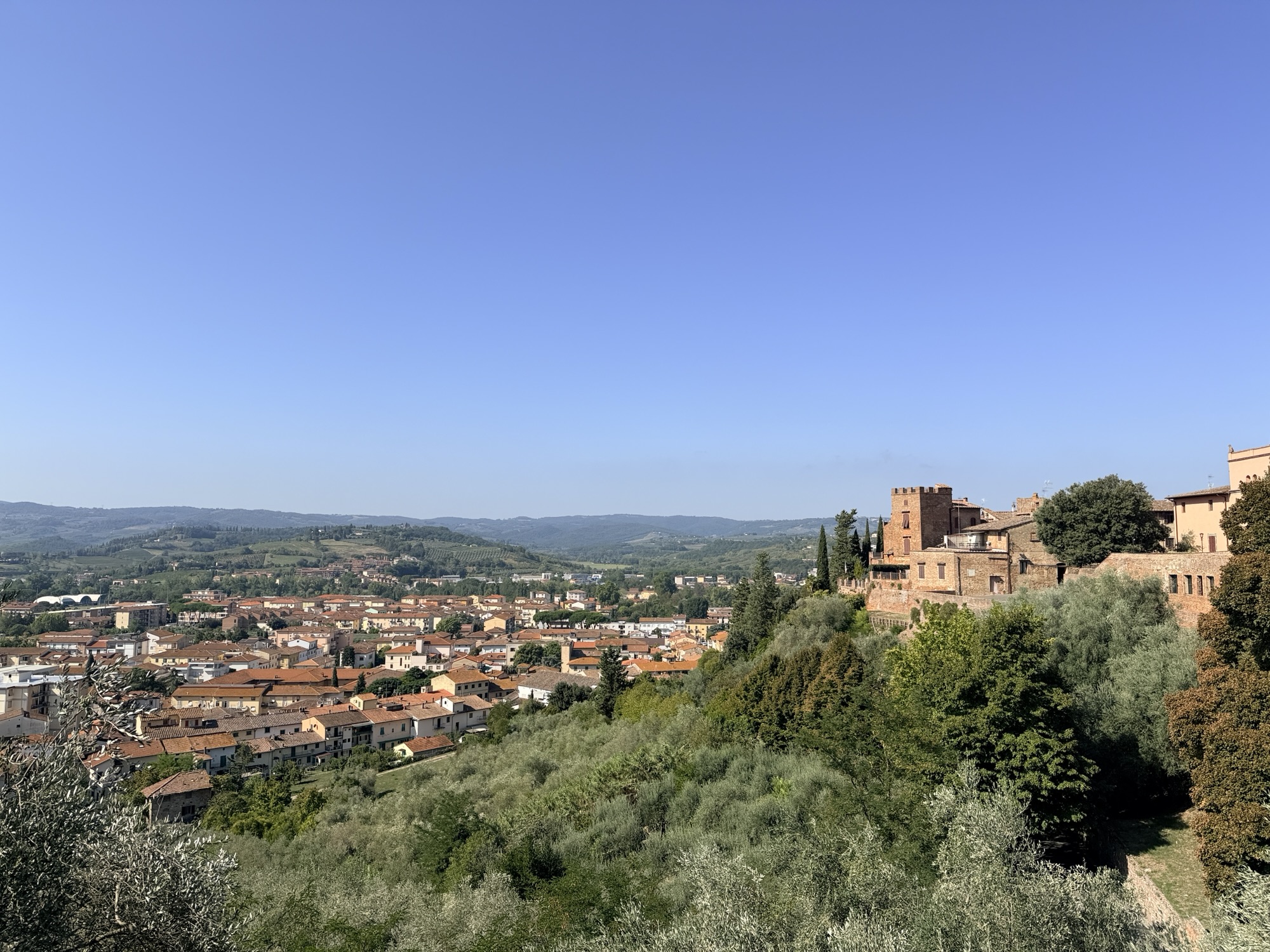
Certaldo Alto sits high enough above the valley to give you sweeping views in almost every direction.
Below is Certaldo Basso, its terracotta roofs clustered around the railway line and modern town.
Beyond it, the landscape rolls away into classic Tuscan countryside.
Olive groves cover the slopes directly beneath the old town.
Cypress trees rise above the surrounding vegetation.
Farmhouses and villages appear on distant ridges.
Vineyards follow the contours of the hills.
It looks exactly the way Tuscany is supposed to look.
Almost suspiciously so.
If someone had walked past carrying a wicker basket filled with grapes while an elderly Italian man played an accordion nearby, I wouldn’t have questioned it.
A Rare Photo of Us
We also managed to take one of the approximately six photos from this trip proving that both of us were actually here.

Behind us was the valley, the lower town and part of the medieval village clinging to the hill.
Travel photography is mostly a collection of photographs of buildings occasionally interrupted by evidence that the photographer exists.
This was one of those interruptions.
Why Certaldo Was Worth the Trip
Certaldo doesn’t have one enormous attraction that brings millions of visitors every year.
There is no Michelangelo’s David.
No Leaning Tower.
No giant cathedral dome dominating the skyline.
And that’s exactly the point.
You come to Certaldo because the town itself is the attraction.
You walk through streets that have followed essentially the same layout for centuries.
You step into small churches containing frescoes that are older than many countries.
You look at coats of arms left behind by medieval officials whose names would otherwise have disappeared completely.
You pass beneath old arches, look down lanes that have been walked for generations and eventually find yourself standing above an olive grove staring across Tuscany.
There is something refreshing about visiting a place where nothing feels urgent.
A Different Side of Tuscany
Florence is spectacular.
But Florence demands your attention.
There is always another museum, another church, another sculpture, another masterpiece and another line of people waiting to see it.
Certaldo asks almost nothing of you.
You arrive.
You wander.
You look at a few frescoes.
You walk some medieval streets.
You stop to stare across the countryside.
Maybe you eat something.
Maybe you have some wine.
There isn’t much more required.
And after several very busy days in Florence, that was exactly what we wanted.
Brick walls warmed by the Tuscan sun.
Empty medieval lanes.
Olive trees spilling down the hillside.
Six-hundred-year-old frescoes still clinging to church walls.
And a landscape that looks suspiciously like every bottle of Italian wine has been using it as a label.
Not a bad way to spend a day in Tuscany.

Justyn Perry
Justyn shares first-hand travel stories, honest recommendations and the practical details that make a journey easier to plan.
More about Billy Goat HikerKeep exploring


The next story, straight to your inbox
Food finds, honest stays, memorable activities and practical travel notes from journeys near and far.
One email when a new story is published. Unsubscribe anytime.