We took the same wine tour that we did four years ago — same company, one of the same wineries, but a different lunch stop and a completely new third winery.
We met near the train station in Florence, where our group of 18 gathered — 10 more people than were on our tour four years ago. Our guide, Alex, was a sommelier, so we knew right from the start that we were in good hands.
Villa Le Corti
Our first stop was Villa Le Corti, which was also our first stop four years ago. The winery had grown since our last visit, but thankfully the wines were just as good.
We toured the production facility again, but this time our timing was perfect: harvest was underway, so we actually got to see grapes arriving and being processed. It added a completely different dimension to the visit compared with our first time here.
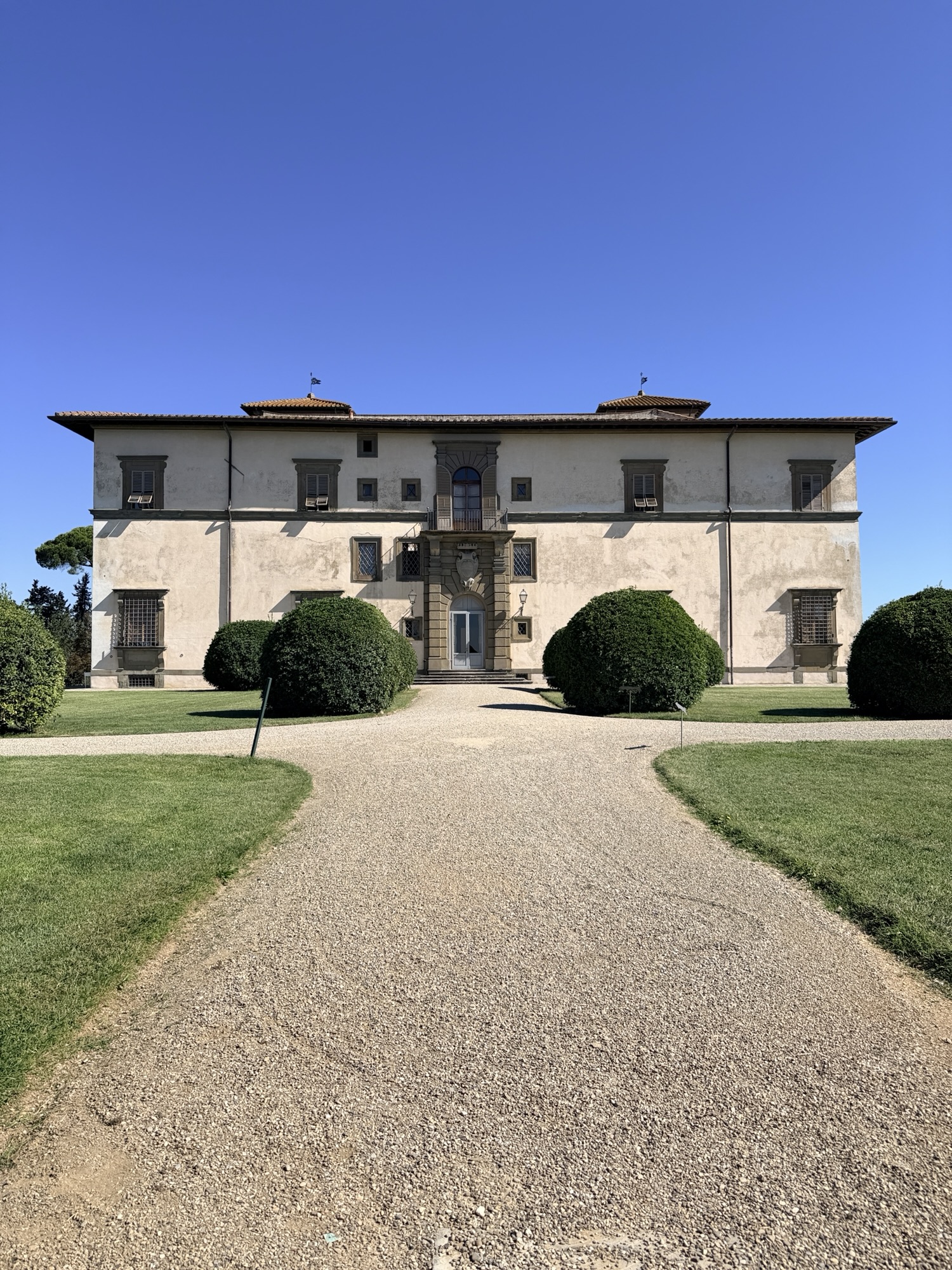
Villa Le Corti is one of those places where the wine is almost secondary to the history surrounding it. Located near San Casciano in Val di Pesa, just south of Florence in the Chianti Classico region, the estate has belonged to the Corsini family since 1363. More than 650 years later, it remains in the family.
The Renaissance villa itself was built in the early 1600s and designed by Santi di Tito, but one of the most interesting parts of the estate is actually underneath it. The enormous wine cellars stretch across three underground levels, much of them beneath the lawn in front of the villa. Their massive vaulted ceilings date from around 1600, and the cellars are still actively used today for producing and aging the estate’s wines.
The estate covers roughly 230 hectares, with about 50 hectares planted with vineyards and another 63 devoted to olive trees. Much of the remainder has been preserved as woodland, helping maintain the biodiversity of the property. Sangiovese is naturally the star here, alongside smaller plantings of other varieties, and the estate has been certified organic since 2015.
Villa Le Corti is also very much an olive estate. The Corsini family has produced olive oil here for centuries, and the property includes a historic olive mill. Between the vineyards, olive groves, Renaissance villa and underground cellars, visiting Villa Le Corti feels less like visiting a modern winery and more like walking through a working piece of Tuscan history.
We sampled three wines: Vermentino, a white; Don Tommaso, which we had also tasted four years ago; and ZAC Chianti Classico Gran Selezione.
And, as seems to be the rule in Italy, you can’t drink without eating. We were served a wonderful assortment of cured meats, bread and Villa Le Corti’s own olive oil.
The Don Tommaso made for an interesting comparison with our first visit. Four years later, it was every bit as good as I remembered — a beautiful ruby red with a long finish. It looked like it should have been heavier on the tongue than it actually was, but instead it remained remarkably smooth. It’s made from 80% Sangiovese and 20% Merlot, and I enjoy what Merlot brings to a blend, so you’ll rarely hear me complain about its inclusion.
The Vermentino was the surprise. Crisp and refreshing, with slight citrus notes, it was exactly the sort of wine that works on a hot Italian day.
But the best of the three was ZAC.
ZAC is 100% Sangiovese, and it had a complexity that became more apparent the longer it sat in the glass and opened up. We’ve had 100% Sangiovese wines before — including some from the Okanagan — but I can’t remember having an Italian one that I enjoyed quite this much.
I digress.
The wine was superb enough that we ended up shipping a case home and carrying another two bottles with us.
The winery itself remains one of the more unique ones we’ve visited. Much of the production and aging takes place underground, naturally helping maintain the temperature and humidity the wine needs, while the historic villa sits above it all with a beautiful garden out front.


The next stop was lunch at Fattoria & Villa Di Rignana.
Fattoria & Villa Di Rignana


Our next stop was lunch at Fattoria & Villa di Rignana, surrounded by vineyards and the rolling hills that you picture when someone says “Tuscany.”
Lunch started with crostini toscani — a trio that included chicken-liver pâté, mushrooms and thinly sliced lardo — followed by truffle mezzaluna and pappardelle with wild-boar ragù.
Everything was paired with two wines from the estate: a Chianti Classico and a Chianti Classico Riserva. Both paired perfectly with lunch, although the Riserva won us over enough that we ordered another glass.
We had a little time to kill before leaving, which of course meant wandering into the wine shop. There we sampled their white and rosé.
The rosé ended up leaving with us.
Funny how that keeps happening.
Tenuta Casenuova
We sampled four wines here, starting with ZIIK, their sparkling rosé made from 100% Sangiovese, followed by three reds. One was Tenuta Casenuove, their Super Tuscan-style IGT blend, followed by two different Chianti Classico expressions. One was a 2019 made from 100% Sangiovese, while the younger wine showed a different side of the grape through changes in blend, aging and winemaking.
My favourite, of course, was the 2019. It was well rounded and full, but still delicate — exactly the kind of Sangiovese I was hoping to find in Tuscany.
We apparently liked this winery too, because we left having ordered another case to ship home and carried a bottle of the ZIIK rosé away with us.
That balance is becoming one of the things I appreciate most about good Sangiovese. There can be plenty going on in the glass without the wine beating you over the head with it.
Apparently we liked Casenuove too, because we left having ordered another mixed case to ship home, plus a bottle of ZIIK rosé to take with us.
I unfortunately didn’t take any pictures at this stop.
Apparently I was too busy drinking the wine.

Justyn Perry
Justyn shares first-hand travel stories, honest recommendations and the practical details that make a journey easier to plan.
More about Billy Goat HikerKeep exploring


The next story, straight to your inbox
Food finds, honest stays, memorable activities and practical travel notes from journeys near and far.
One email when a new story is published. Unsubscribe anytime.