Florence felt chaotic when we arrived.
The streets were packed with people, most of them tourists moving from one sight to another sight. Everywhere you looked, someone was staring at a phone trying to figure out where they were, or holding one up to capture the perfect Instagram photo.
It was jarring because we had been here before.
Four years ago, near the end of the pandemic, Florence had been almost unnaturally quiet. You could walk down a street without feeling like a salmon swimming against the current. English wasn’t nearly as common, restaurants felt more local, and some of the places we found became favourites.
Coming back this time was different.
Some of those old haunts were still there and the food was still good, but they felt as though they had discovered tourism in the years since. Busier. Slicker. A little oversold.
English was suddenly everywhere. Servers seemed exhausted. Restaurants were hectic. Central Florence sometimes felt like it was constantly advertising itself — hotels, Airbnbs, restaurants and attractions all competing for the next visitor.
For the first couple of days, Florence simply felt busy.
Then we started finding Florence again.
Getting Away From the Sights
The longer we stayed, the easier the city became.
We learned which streets to avoid. I started remembering side streets and alternate routes and eventually barely looked at a map at all.
More importantly, we discovered the remaining pockets where Florence still seemed to belong primarily to the people who lived there.
Piazza della Santissima Annunziata became one of them.
We spent some wonderful evenings there, sometimes sitting with drinks at 10 p.m. while locals gathered around us. One evening there was live music. Another brought a lantern festival and fireworks. During our stay, a once-a-year market filled the piazza with farmers and producers from the surrounding countryside.
Then there was Sant’Ambrogio.
We returned to that neighbourhood several times for dinner. The amount of English being spoken dropped dramatically, tourists became scarce, and the restaurants felt different. Less hurried. Less rehearsed.
And near Porta di San Frediano, we found an incredibly busy restaurant with a line of locals waiting outside.
The menu was simple: a couple of pastas, a handful of meat dishes, food that tasted like somebody’s nonna was still in charge of the kitchen.
We ordered house wine by the litre.
Instead, they dropped a magnum on the table and explained that we could drink as much as we wanted and they would charge us for whatever was gone when we finished.
The bottle was empty when we left.
That was probably inevitable.


Eating Our Way Through Tuscany
Ten days also gave us enough time to move beyond sampling Tuscan food and actually start forming opinions about it.
We tried virtually every traditional dish we came across.
There was bistecca alla Fiorentina, which absolutely lived up to its reputation. The steak was incredibly tender, full of flavour and one of those dishes that immediately explains why it became iconic.
There was lampredotto, Florence’s famous tripe sandwich.
It was good.
I’m also perfectly happy having eaten it once.
There was finocchiona, the Tuscan fennel salami that appeared on more than one board of cured meats and cheese.
There was wild boar.
Lots of wild boar.
Every wild-boar ragù was slightly different — some richer, some more tomato-heavy, some darker and more deeply flavoured. We enjoyed it, but after ten days in Tuscany we were completely prepared to leave the boar behind.
And then there was truffle.
I gained an entirely new appreciation for it in Florence.
I had never really understood why some truffle dishes were incredible while others tasted almost artificial. After eating enough of it, the difference became obvious.
Good truffle is creamy, earthy, soft and surprisingly delicate.
Bad truffle tastes like chemicals and plastic and somehow manages to burn slightly at the back of your throat.
Once you know the difference, you can’t unknow it.
House wine, meanwhile, was consistently good almost everywhere we went. Ordering a half-litre or litre with dinner became so normal that bottled wine sometimes felt unnecessarily complicated.


Florence on Steroids: The Uffizi
Then there was the Uffizi.
The only way I can describe it is culture on steroids.
You move from room to room past artists whose names normally occupy entire chapters in art-history books: Botticelli, Raphael, Leonardo da Vinci, Caravaggio and Rembrandt.
Suddenly, The Birth of Venus isn’t an image printed on a textbook page. It’s directly in front of you.
So is Botticelli’s Primavera.
Caravaggio’s Medusa stares back at you from behind glass.
Raphael, Leonardo, Rembrandt — after a while the sheer concentration of important art becomes almost absurd.
It was overwhelming at times. The crowds certainly didn’t help.
But it was absolutely worth it.
The building itself was almost as fascinating as the collection. Ceilings, corridors, decoration and architecture competed constantly with the paintings hanging beneath them.
The Uffizi originally began as offices for Cosimo I de’ Medici — uffizi literally means “offices” — but today it feels like an enormous palace devoted entirely to preserving beauty.
By the end, visual overload had definitely set in.
There are only so many masterpieces your brain can absorb in one afternoon.


The Florence Between the Attractions
Curtis said something while we were walking one day that stuck with me.
In Florence, you turn a corner and there’s a church from the 1500s. Turn another corner and there’s a postcard. Turn again and there’s a statue of someone whose name you recognize from a history book.
Once we stopped walking to attractions and simply started walking through Florence, those details became more interesting.
We noticed buildings that were immaculately maintained beside others whose stone and plaster had clearly seen better centuries.
But appearance could be deceptive.
A façade might look worn and weathered from the street, yet through a doorway you would catch a glimpse of a beautifully renovated apartment, plants in a courtyard or families living comfortably inside.
The outside had aged.
The inside was still a home.
That became one of my favourite things about Florence.
Central Florence sometimes seemed desperate for visitors, with accommodation signs everywhere and businesses competing for attention.
The architecture seemed completely indifferent to all of it.
Those buildings had already watched Florence change for hundreds of years. Tourism was simply another snapshot in their existence.
Tourist Florence and Local Florence
We also took a cooking class.
It was fun, but nobody was going to mistake it for spending an afternoon in an Italian grandmother’s kitchen.
There were probably fifty or sixty people divided into smaller groups, and the whole operation was clearly designed to move tourists efficiently through the experience.
Our instructor made it entertaining.
Not thin enough?
Keep rolling.
Wrong shape?
Do it again.
Always delivered with a smile and a chuckle.
It was mass-produced, but enjoyable.

The market at Santissima Annunziata was almost the exact opposite.
There, we had to figure things out.
Many of the farmers spoke little or no English. Nobody was adjusting the experience for us. We pointed, asked questions, tried our Italian and worked it out.
Fresh olive oil.
Sun-dried tomatoes.
Dried figs.
Cheeses we would never see at home.
And bread that somehow felt loved.
We brought everything back and made our own charcuterie board.
It was such a simple experience, but it felt far more connected to Florence than many of the things designed specifically for visitors.
For a little while, we weren’t watching local life.
We had melted into it.
Florence After Dark
And then nighttime came.
Florence at night felt like an entirely different city.
You could breathe.
The streets became calmer and more collected, almost as though the city itself had decided the day was finished and everyone could finally relax.
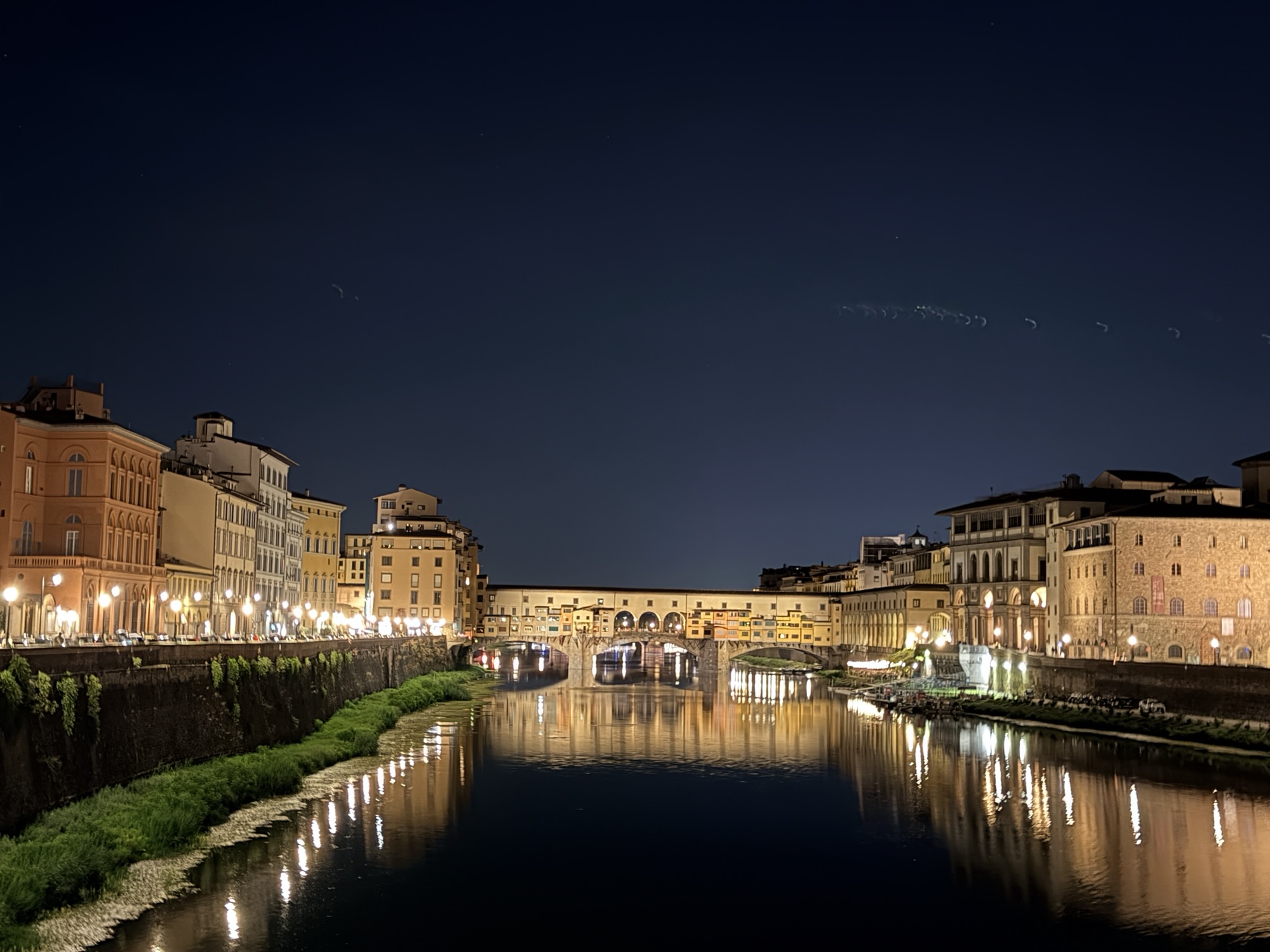
Some of my strongest memories of Florence will be our evening walks along the Arno.
The buildings reflected in the river. Ponte Vecchio glowing in the distance. Locals coming outside while many tourists disappeared back into their hotels, presumably preparing for the next morning’s war of the sights.
Italy as a whole understands evening culture in a way that North America often doesn’t.
Don’t rush to dinner at six.
Or seven.
Sometimes not even eight.
If you want to eat surrounded by locals, go at 8:30 or later.
Sit down.
Order wine.
And stop looking at the clock.
There is something about the sidewalk culture here that we simply don’t do very well back home.
Life pauses over food made with care.
It settles over a glass of wine and laughter.
Friends catch up in the piazza while their children play nearby.
People talk about their day, their week, their families — not because it’s a scheduled activity, but simply because this is what evenings are for.
Sitting in those piazzas at night made me wonder if perhaps that is what life is supposed to be about.
Not everything that happens during the day.
But who you spend the evening with afterward.


Ten Days Later
By the end of ten days, Florence felt completely different from the city we had arrived in.
It felt warm.
Familiar.
Welcoming.
We had our routes. Our neighbourhoods. Our restaurants.
We even had a local café where, toward the end, the woman behind the counter would see us walk in and begin making our coffees before we ordered.
That tiny moment probably says more about our time in Florence than any major attraction could.
The Florence we remembered from four years earlier was still there.
It was busier now.
More touristy.
A little less local.
But it hadn’t disappeared.
We just had to stay long enough to find it.
Somewhere during those ten days, Florence stopped being a collection of sights we were trying to visit and became a city we knew how to move through.
And that was the Florence I wanted to remember.

Justyn Perry
Justyn shares first-hand travel stories, honest recommendations and the practical details that make a journey easier to plan.
More about Billy Goat HikerKeep exploring


The next story, straight to your inbox
Food finds, honest stays, memorable activities and practical travel notes from journeys near and far.
One email when a new story is published. Unsubscribe anytime.