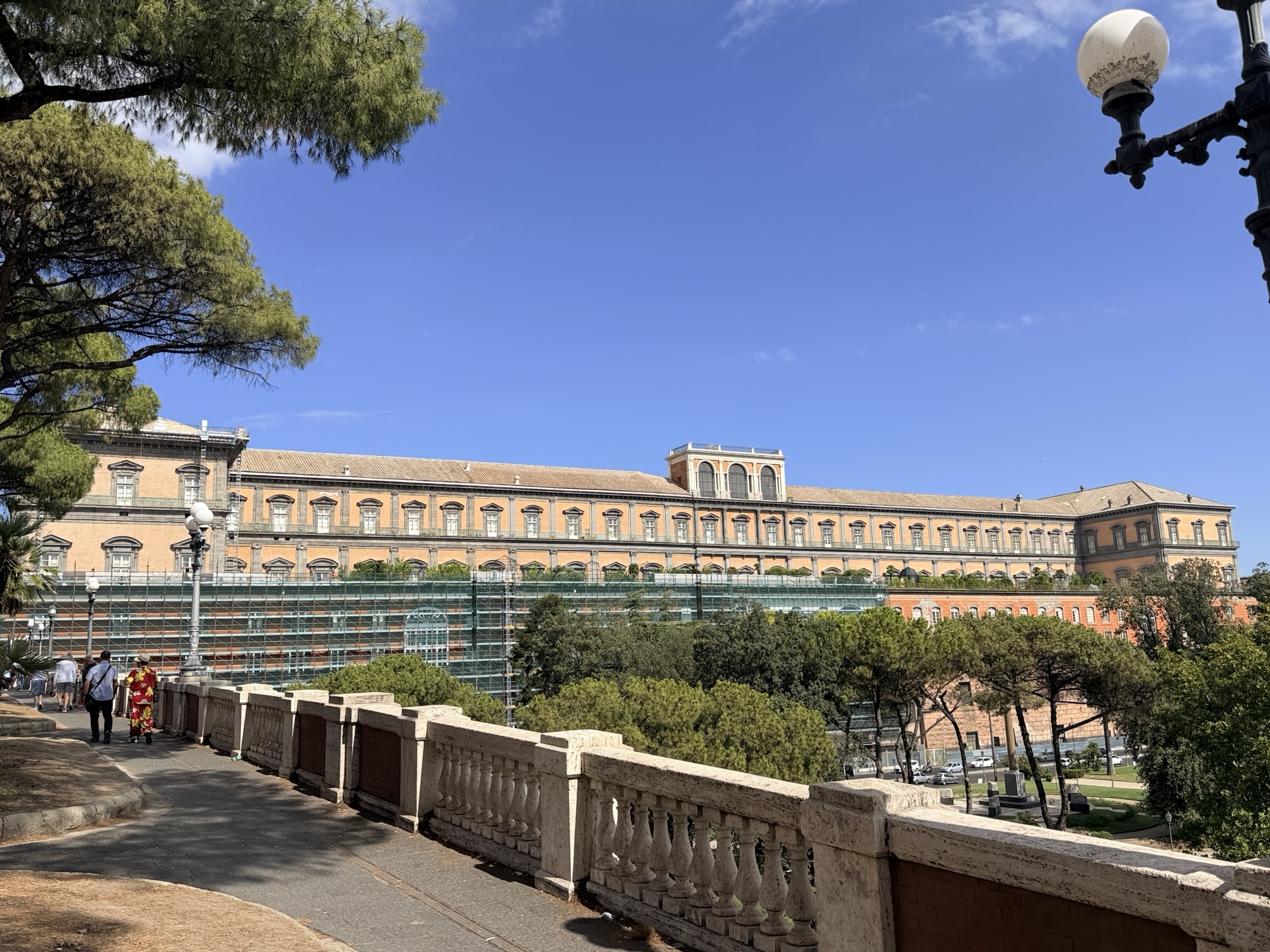
Naples felt like a checkbox.
It was one of those places we felt we should experience at least once — a major Italian metropolis packed with people, history, traffic, noise, garbage and, supposedly, some of the best pizza in the world.
Within a few hours, it was pretty clear that Naples was going to be very different from Florence.
Florence had felt like a young thinker: cultured, composed and constantly showing you something beautiful.
Naples felt more like an old dame who had stopped caring what anyone thought of her.
The streets were cluttered. Buildings were worn. Garbage appeared everywhere. Balconies spilled over narrow streets, wires crossed overhead, scooters slipped through impossible gaps and cars seemed to operate according to traffic rules that existed only in theory.
And crossing the street?
That became a game of Frogger.
Our strategy eventually became fairly simple: wait, count to ten, hope for the best and step out.
The cars will stop.
Or they’ll go around you.
Probably.


Naples Wasn’t Pretty — But It Felt Real
What surprised me was that Naples never actually felt unsafe.
The grunge made us more cautious, but nothing happened that justified that feeling. It was more instinct than experience. The worn buildings, overflowing garbage, narrow streets and constant traffic simply kept us more alert than we had been elsewhere.
And after a while, we started getting used to it.
Not necessarily liking it.
But understanding it.
Naples felt authentic in a way that some other heavily visited cities no longer do. It didn’t seem particularly interested in polishing itself for us.
It simply existed as Naples.
The City of Contrasts
Naples seemed to specialize in contradictions.
One of the clearest examples was walking through the grand Galleria Umberto I and then, only a couple of blocks later, finding ourselves in streets that felt dramatically poorer and more worn.
There was almost no gradual transition between the two.
One moment there was soaring glass, elaborate architecture and monumental grandeur.
The next there were crumbling façades, laundry hanging from balconies and narrow streets filled with everyday life.
That contrast was everywhere.
We only went into one church during our stay, but it showed us another side of the city.
Outside was the noise and clutter we had already become accustomed to.
Inside was colour, art and a beautifully maintained space that felt almost disconnected from the streets beyond the doors.
By then, we knew what was waiting outside, which somehow made the contrast even more interesting.
There was beauty in the rough.


Then There Was the Pizza
I was expecting pizza.
What arrived was pizza taken ridiculously seriously.
The tomato sauce was simple but deeply flavourful. The ingredients tasted fresh and intentional — nothing seemed to be there simply because somebody thought the pizza needed another topping.
Everything belonged.
And it was fast.
From ordering to the pizza landing on our table was maybe five to seven minutes, and it arrived smoking hot.
The crust was fresh, the centre soft, and the whole thing tasted like something that had been refined through generations of people who knew exactly what they were doing.
Naples may have tested my patience in a lot of ways.
The pizza absolutely did not.


Naples After Dark
Our street was relatively quiet during the day.
At night, it transformed.
Restaurants filled up, sidewalks became crowded and suddenly there were people everywhere.
But unlike Florence, where nighttime had made the city feel more local and relaxed, Naples sometimes felt more artificial after dark.
The crowd seemed heavily tourist-oriented. Restaurants competed for passing customers, people tried to pull you toward tables, and the atmosphere felt more manufactured than spontaneous.
Oddly enough, the rougher parts of Naples often felt more authentic than the parts supposedly designed to welcome visitors.
Three Nights Was Enough
By the end of our three nights, we had adjusted to Naples.
We learned how to cross the streets.
We understood the traffic a little better.
We stopped being surprised by the garbage.
We appreciated the contrast between grand architecture and worn neighbourhoods.
And we ate some absolutely incredible pizza.
But we were also ready to leave.
Naples never became somewhere I fell in love with, and I don’t think every destination needs to.
Sometimes travelling is simply about experiencing a place for yourself rather than deciding beforehand what you are supposed to think about it.
I’m glad we saw Naples.
I’m glad we experienced the noise, the traffic, the contradictions and the strange rhythm of the city.
I’m very glad we ate the pizza.
But three nights was enough.
Naples felt like somewhere I needed to experience once — not somewhere I immediately wanted to return to.
Unless, of course, someone puts one of those pizzas in front of me again.

Justyn Perry
Justyn shares first-hand travel stories, honest recommendations and the practical details that make a journey easier to plan.
More about Billy Goat HikerKeep exploring


The next story, straight to your inbox
Food finds, honest stays, memorable activities and practical travel notes from journeys near and far.
One email when a new story is published. Unsubscribe anytime.