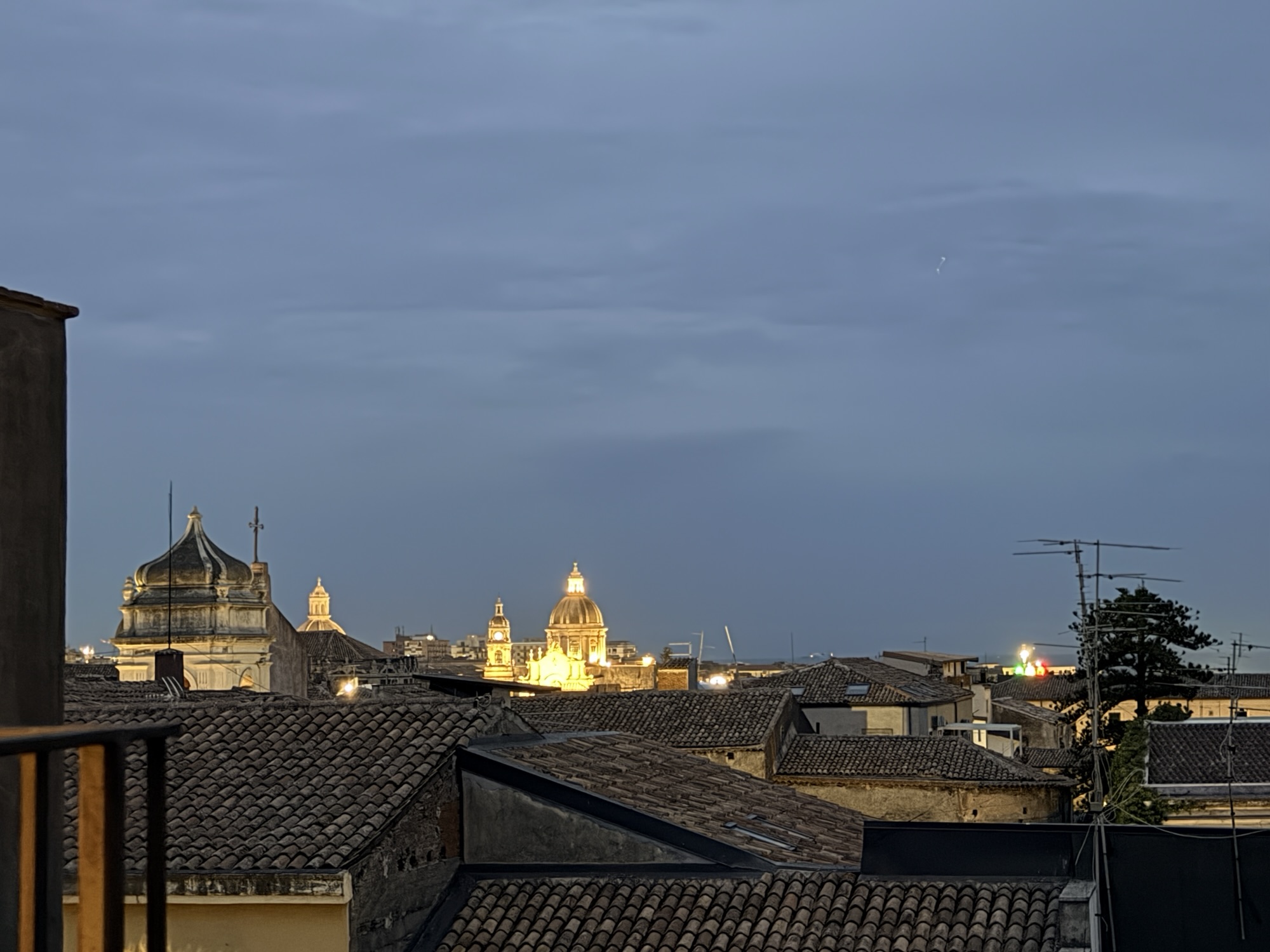
Catania reminded us of Naples almost immediately.
But with the volume turned down.
There was traffic everywhere, scooters weaving through cars and that constant sense of movement we had become familiar with farther north. Somehow, though, it never tipped into chaos. Everything seemed to flow around everything else in a way that was almost poetic.
It wasn’t as clean or polished as Cosenza, but it also didn’t have the grime and intensity we had felt in Naples.
Catania seemed comfortable somewhere in between.
And then there was the stone.
A City Built From the Volcano
Once we noticed the volcanic stone, we couldn’t stop seeing it.
It was everywhere.
Roads. Buildings. Churches. Fountains. Monuments. Walls.
Dark stone ran through the city as though Etna had left fingerprints on everything below it.
We arrived on a Saturday, so there was an energy around but not chaos like we thought there might be. We had done some research on restaurants and decided to head over to one at 8:00pm. Good food, good wine and a server that seemed to know best….
And then we were introduced to almond wine.
It was one of those discoveries where you think, Oh, we’ll definitely find this again.
We did not.
We looked.
Apparently we should have bought a bottle when we had the chance.
That seems to be becoming a theme.
It turned out to be a pretty good introduction.

Sunday in Catania
Catania definitely had its tourist zone.
You could feel when you entered it.
Restaurants competed for attention, menus seemed designed for visitors and the whole thing had that slightly manufactured atmosphere we had learned to recognize pretty quickly.
Normally, we would simply walk another few streets and find somewhere more local.
Sunday made that harder.
Sunday was a self guided tour around old town. We made our way to Castello Ursino and learned more about just how much Catania’s history has been shaped by the volcano looming behind it. The city we were walking through wasn’t simply built beside Etna. Destruction and rebuilding had become part of its story.
That suddenly made all that black stone feel different.
It wasn’t just an architectural choice.
It was the landscape becoming the city.
Then we walked to the Duomo. A cathedral equally as large but something seemed slightly different from the Florence Duomo or the Milan Duomo – this one felt newer and more baroque or Victorian. Everything was newer than 1693 – while that seems old, from Italian standards, it’s considered new.
Come dinner, we struggled to find things that were open except for the tourist areas.
A lot of the restaurants we actually wanted to try were closed, leaving us wandering considerably longer than expected in search of dinner.
Eventually we found somewhere that felt authentic enough – seemed busy with locals.
The food was good.
The wine was good and local – paired well with the food.


Up to Etna
Our wine day began in Taormina.
Taormina was beautiful.
Taormina was also packed.
Driving through town was enough to make us glad we hadn’t stayed there. We had heard how expensive it could be, and the sheer number of tourists confirmed that it probably wasn’t what we were looking for on this trip.
It was a nice place to meet the tour.
Then we were happy to leave.
As we climbed toward Etna, Sicily started changing.
The best comparison we could come up with was Italy meets Hawaii.
Black volcanic earth cut through a landscape that was otherwise unmistakably Mediterranean. Vineyards climbed the slopes in terraces, with stone walls running across the hillsides.
Everything felt shaped by elevation.
The vineyards we visited sat high on Etna, roughly between 750 and 1,000 metres, where grapes were growing in conditions very different from the warm, rolling vineyards we had seen elsewhere in Italy.
By this point in the trip, we had visited enough wineries that we knew the process.
Fermentation tanks.
Barrels.
Bottling.
Aging.
We weren’t really there to learn how wine was made anymore.
What became far more interesting was where it was being made.
The altitude.
The lava.
The terraces.
The climate.
The mountain.
Etna was the story.


One Very Big Family Winery
We visited one winery, and it was a substantial operation.
There was a lot of wine being produced.
It felt commercial in scale, but not corporate. There was still a family behind it, which kept the experience from feeling completely industrial.
Our group was good, which always makes a difference on these tours.
And the wine was good.
But increasingly, what we remembered afterward wasn’t the machinery or production process.
It was walking outside.
Seeing the terraces.
Looking across black volcanic ground covered in vines.
Understanding that this wine could only really come from this place.
That was far more interesting than another fermentation tank.
Lunch, With a Lot of Plating
Lunch was at a different location.
The food was excellent.
The wine was excellent.
But the restaurant seemed to be trying very hard to be a fancy restaurant.
A tremendous amount of care went into presentation. Everything was carefully arranged and beautifully plated.
Nothing was actually wrong with it.
It had simply lost some of that small-family-trattoria warmth we had come to appreciate so much.
Sometimes the most memorable food on this trip had arrived without ceremony.
A plate placed on the table by someone whose family had probably been making the same thing for decades.
No tweezers required.
That evening, though, I did have one dish that absolutely worked: pistachio and shrimp pasta.
Sicily does pistachio very well.
Catania Without a Plan
Our other full day in Catania was probably our favourite way to experience the city.
We stopped trying to see things.
We went to the fish market.
Then we wandered.
The market gave us a completely different Catania from the quiet Sunday we had first encountered. There was movement everywhere — fish, seafood, vendors, shoppers, voices echoing between buildings.
This was a working market rather than an attraction pretending to be one.
Afterward, we disappeared into the smaller streets discovering an old Benedictine monastery, university split by a piazza, and a gate that was a wedding gift.
No real destination.
No checklist.
Just Catania.


Those are often our favourite travel days.
Eventually we made our way back to the apartment, opened some wine and did absolutely nothing for a while.
Then it was time to find dinner.
When Nonna Is Still Cooking
That evening we found exactly the kind of restaurant we had been searching for.
Small.
Unpretentious.
Local.
And Nonna was still in the kitchen.
That is generally a very good sign.
I ordered tuna and onion.
Simple ingredients, prepared well, without trying to turn them into something they weren’t.
It was the complete opposite of the carefully plated lunch on the wine tour.
And that was precisely why it worked.
The food felt connected to the place rather than designed to impress us.
Then came another Sicilian discovery.
Unnimaffissu.

We had been asking about Amara when the name came up, and at first we weren’t even sure what we had heard.
It sounded nothing like what we expected.
Then the bottle appeared.
It was lighter and much sweeter than the amari we had been drinking throughout Italy, almost more like a sweet liqueur than the bitter digestifs we had become accustomed to.
Completely unexpected.
Completely memorable.
Catania Found Its Own Rhythm
Catania never tried very hard to impress us.
And maybe that was why we liked it.
It had beautiful buildings, but they were often surrounded by worn ones.
It had tourist streets, but you could escape them quickly.
It had traffic, but somehow it flowed.
It had dirt and decay, but neither defined the city.
And everywhere you looked, Etna was present even when you couldn’t see the mountain itself.
In the black roads.
In the walls.
In the wine.
In the food.
Catania felt like a city that had learned to live with something immensely powerful sitting above it.
Naples had felt chaotic.
Cosenza had surprised us with its calm.
Catania found a space somewhere between them.
Busy without being overwhelming.
Rough without feeling dirty.
Touristic without completely surrendering itself to tourism.
We came for a few days.
We wandered.
We drank Etna wine.
We ate tuna and onions cooked by someone’s Nonna.
We discovered almond wine and Unnimaffissu.
And somewhere along the way, Catania quietly won us over.

Justyn Perry
Justyn shares first-hand travel stories, honest recommendations and the practical details that make a journey easier to plan.
More about Billy Goat HikerKeep exploring


The next story, straight to your inbox
Food finds, honest stays, memorable activities and practical travel notes from journeys near and far.
One email when a new story is published. Unsubscribe anytime.