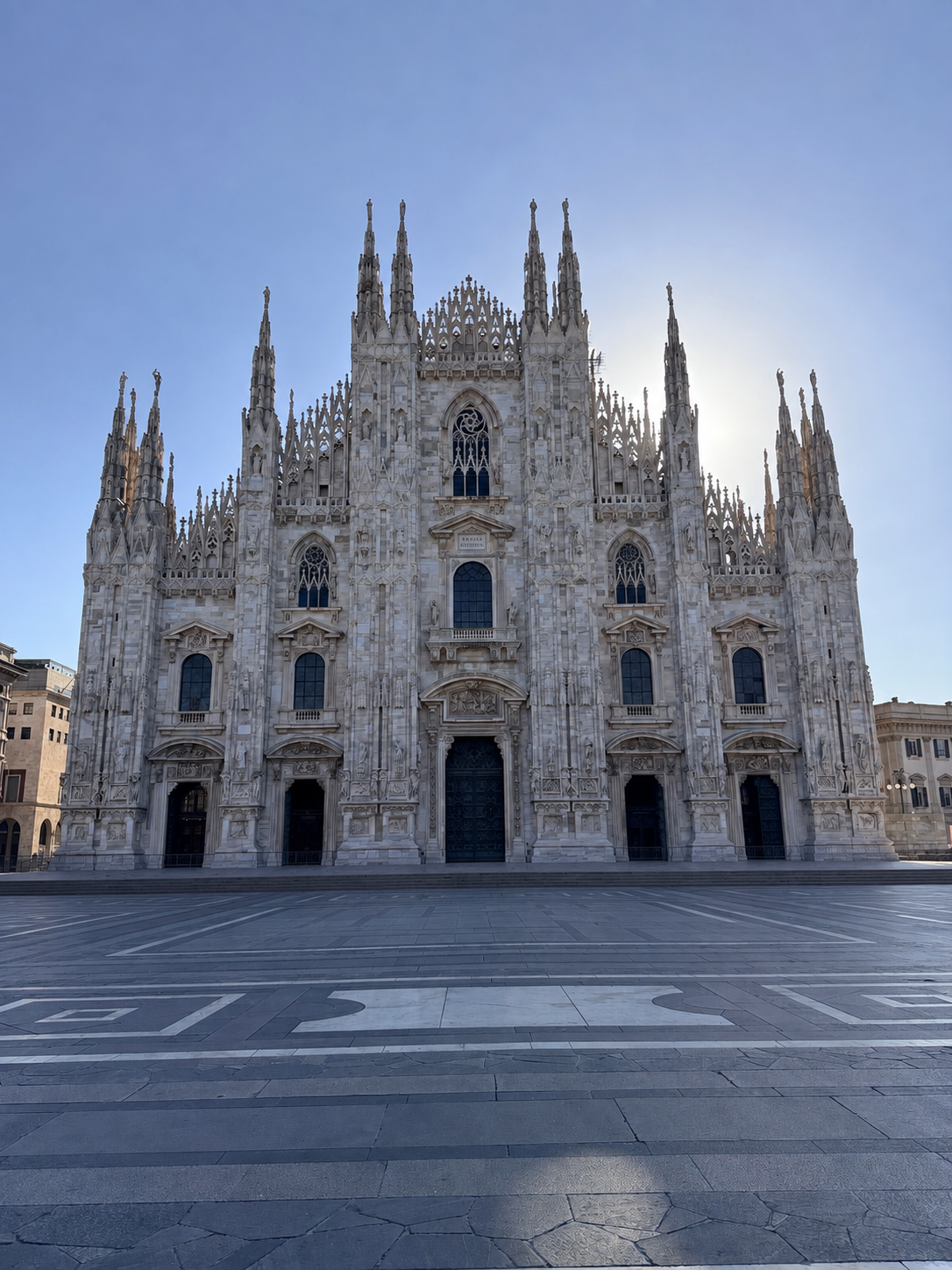
The Milan Duomo began construction in 1386 and wasn’t considered fully completed until 1965 — nearly 600 years of construction. The cathedral is built largely from Candoglia marble, quarried near Lake Maggiore in Piedmont and historically transported to Milan by river and canal.
The Duomo also has some fascinating astronomical features. Near the main entrance is a brass meridian line marked with the signs of the zodiac. A small hole high in the cathedral allows a beam of sunlight to fall onto the line at solar noon, helping astronomers determine the date and season and establish true midday.
The cathedral is hugely important to Milan and the Catholic Church, but the site was sacred long before the current Duomo existed. Earlier Christian basilicas and a baptistery stood here, with documented Christian worship on the site dating back to at least the 4th century AD — more than 1,600 years.
There’s also a surprising amount of numerology and symbolism worked into the Duomo’s design. The vast interior is supported by 52 enormous columns, traditionally associated with the 52 weeks of the year. The number 8 also appears repeatedly: the ancient baptistery beneath the Duomo was octagonal, the central crossing follows an eight-sided design, and the roof includes groups of spires arranged in sets of eight. In Christian symbolism, eight represents the “eighth day” — the Resurrection and the beginning of a new creation.
That symbolism continues upward. The Duomo has 134 spires, with the golden Madonnina standing on the highest central spire. The spires are populated by an extraordinary collection of statues — saints, martyrs, warriors, historical and mythical figures, animals and monsters — creating almost a procession from the earthly world below toward the Virgin and heaven above. Combined with the zodiac meridian on the floor, the cathedral mixes religion, mathematics, astronomy and symbolism in ways that aren’t immediately obvious when you first walk in.
Even the ceiling isn’t quite what it looks like. Much of the elaborate Gothic tracery across the Duomo’s soaring vaults is actually painted decoration designed to imitate carved marble in three dimensions. The faux-marble fretwork was added largely during the 19th century, using shading and perspective to make the flat painted surfaces appear sculpted from the floor below. From that distance, the illusion is remarkably convincing.
High above the main altar is one of the Duomo’s most important relics: the Santo Chiodo, a nail traditionally believed to have been used in the Crucifixion of Christ. It is kept in a tabernacle near the top of the cathedral vault, marked by a red light. Each September, the Archbishop is raised roughly 45 metres on an elaborate cloud-shaped lift called the Nivola to retrieve the relic and bring it down for public veneration.


Justyn Perry
Justyn shares first-hand travel stories, honest recommendations and the practical details that make a journey easier to plan.
More about Billy Goat HikerKeep exploring


The next story, straight to your inbox
Food finds, honest stays, memorable activities and practical travel notes from journeys near and far.
One email when a new story is published. Unsubscribe anytime.