We spent a few days in Milan and did quite a bit of wandering around the city. Obviously the Duomo was one of the main reasons for being there, but there was a lot more to see around Milan than just the cathedral.
Milan is a strange mix of really old buildings, ridiculously grand buildings, modern fashion, trams, food, and a lot of people who seem much better dressed than us.
Walking Around Milan

While walking towards the fashion district, we came across these old stone arches sitting in the middle of the street. They are the medieval Porta Nuova.
The gate dates back to the rebuilding of Milan’s city walls in the late 1100s after the city was largely destroyed by Frederick Barbarossa in 1162. Somehow, nearly 850 years later, it is still standing while cars and trams travel right through it.
I always find things like this interesting in European cities. There isn’t necessarily a big park or monument built around it; they just incorporated an 800-year-old city gate into the road and carried on.
Galleria Vittorio Emanuele II


Right beside the Duomo is the Galleria Vittorio Emanuele II.
The Galleria was built between 1865 and 1877 and connects Piazza del Duomo with Piazza della Scala. It was named after Vittorio Emanuele II, the first king of a unified Italy.
The building is impressive. The entire shopping area is covered by a massive glass and iron roof with a large glass dome over the centre. The floors are covered in mosaics and the buildings underneath are incredibly detailed.
And then there are the stores.
Prada, Louis Vuitton and just about every other expensive brand you can think of has a store in here. We did not suddenly become wealthy while in Milan, so looking at the architecture was considerably cheaper.

Even if you have absolutely no interest in shopping, it is worth walking through. It feels more like a monument that happens to contain stores than a shopping centre.
Vittorio Emanuele II

Outside the Galleria, in Piazza del Duomo, is a large monument to Vittorio Emanuele II.
His name comes up a lot while travelling through Italy. He became the first king of the unified Kingdom of Italy in 1861, so there are streets, monuments and buildings named after him all over the country.
The statue in Milan has him sitting on horseback overlooking the piazza, only a short distance from the Galleria that also carries his name.
Food
Of course, we also ate.


One of the meals we had was a Milanese-style pork cutlet. The traditional cotoletta alla milanese is normally made with veal, but this one was pork. It was breaded, fried and enormous.
Not exactly a light dinner, but after walking around Milan all day I wasn’t particularly concerned about that.
Another meal was gnocchi verde covered in a creamy sauce.
We’ve eaten a lot of pasta and gnocchi since arriving in Italy and I don’t really see that changing anytime soon.
Milano Centrale


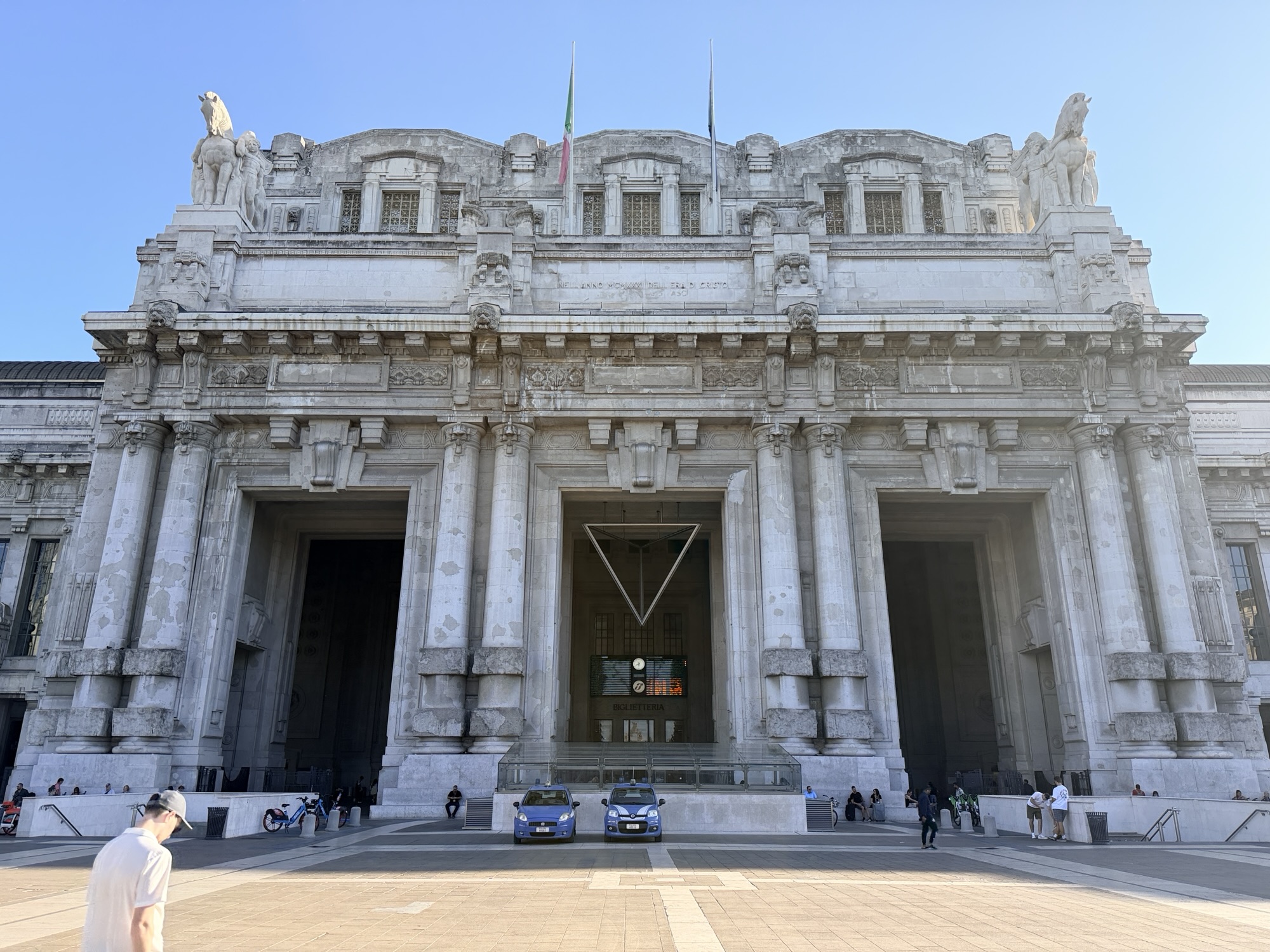
Our main transportation point in Milan was Milano Centrale.
Calling this place a train station seems slightly inadequate.
The current station opened in 1931 and was designed by Ulisse Stacchini. The architecture is a mixture of different styles, including classical and Art Deco influences, and the entire thing was built on a massive scale.
From outside, it looks more like some kind of government building or monument than somewhere you go to catch a train.
The inside isn’t much more subtle.
The main halls have enormous arched ceilings, stone carvings, statues and reliefs covering the walls. If they were trying to make arriving by train feel important, they succeeded.
It is also huge. We used Centrale several times while travelling around northern Italy and eventually got used to navigating it, but the first time through involved a fair amount of looking around trying to figure out where we were supposed to go.
Getting Around
Milan was fairly easy to get around. We used the Metro when we needed to cover larger distances and walked for most of the rest.
Walking was probably the better option anyway because we kept finding things that we wouldn’t have seen otherwise. The medieval Porta Nuova was a good example. We weren’t specifically looking for it; it was simply there along the route.
There are also trams running everywhere, including some of the older yellow ones that look considerably more interesting than a modern city bus.
In Summary
Milan felt very urban and European. Finding restaurants that were open in August was challenging and frustrating but we managed.
You can walk from one of the largest Gothic cathedrals in the world, through a 19th-century glass shopping arcade filled with luxury stores, past medieval city gates, onto a Metro, and eventually end up inside a train station that looks like someone designed it to intimidate neighbouring countries.
Somewhere along the way we crossed the 150km walked mark and it’s only been 2 weeks.

Justyn Perry
Justyn shares first-hand travel stories, honest recommendations and the practical details that make a journey easier to plan.
More about Billy Goat HikerKeep exploring


The next story, straight to your inbox
Food finds, honest stays, memorable activities and practical travel notes from journeys near and far.
One email when a new story is published. Unsubscribe anytime.