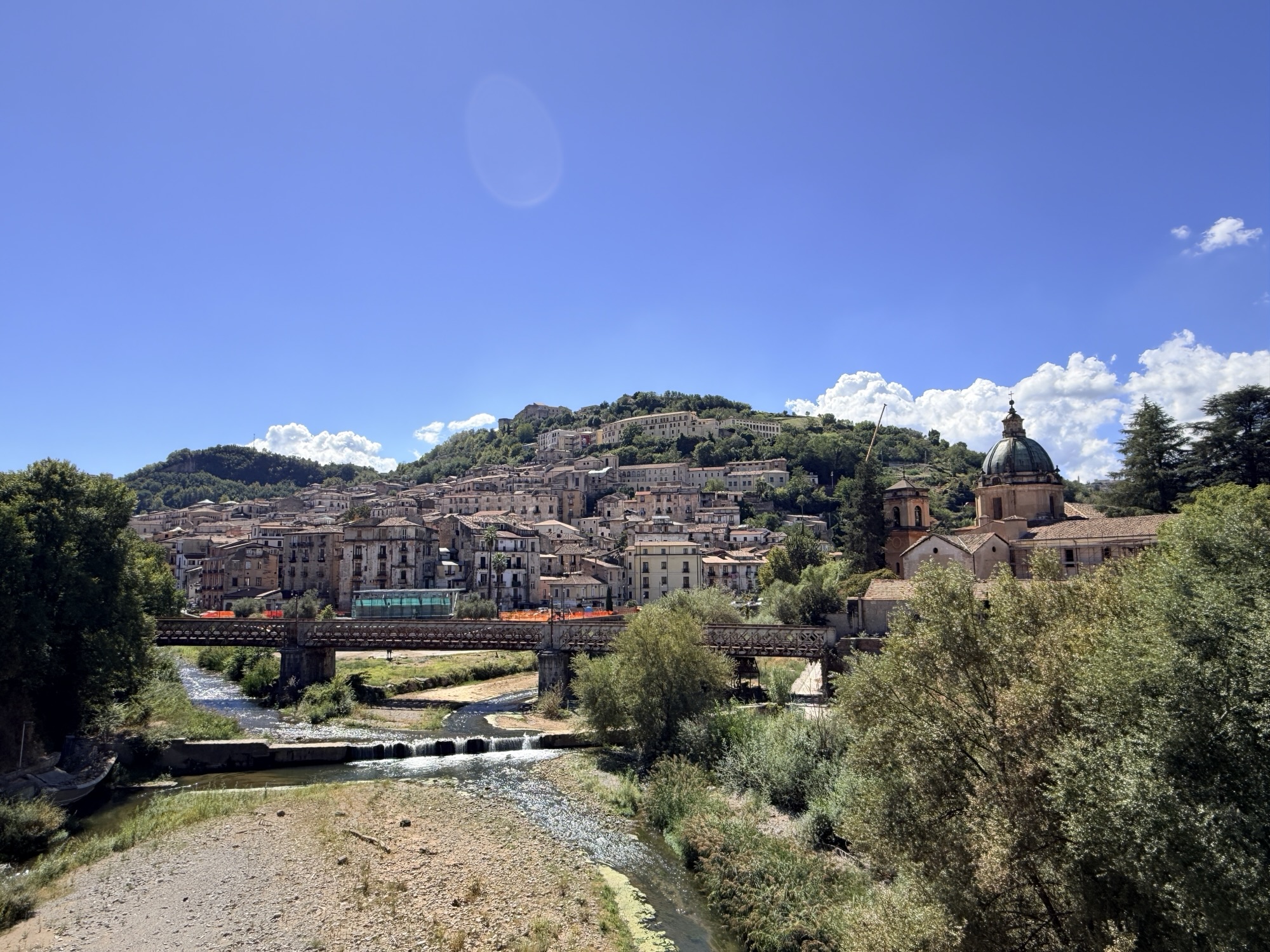
Calabria turned out to be a lesson in first impressions.
The place we arrived expecting very little from became somewhere we wanted more time. The place we had been looking forward to became somewhere we probably would have skipped.
And somewhere in between, Calabria kept reminding us that the best parts of travel are often the ones you don’t plan.
Cosenza – We Misjudged You
Our introduction to Cosenza wasn’t exactly warm.
The train station felt strangely grand for the city it served — oversized and almost monumental. Combined with the architecture around it, our immediate reaction was that Cosenza had a bit of an Eastern Bloc feeling to it: big, functional and slightly cold.
Then we tried to take the bus.
We couldn’t figure out where to buy tickets. We looked around, tried to sort out the machines, and eventually boarded with cash in hand, hoping the driver could sell us one.
He couldn’t.
We tried to give him the money anyway.
He refused it, waved us onto the bus and carried on.
That should probably have been our first indication that we had Cosenza wrong.
The bus took us through the city toward the centre, where our Airbnb host was waiting for us. And after weeks of European apartments, we walked into what felt like a palace.
It was huge.
The décor was some wonderful collision of avant-garde and mid-century modern: interesting furniture, bold pieces, lots of space and absolutely nothing resembling the cramped apartments we had become accustomed to.
Things were already improving.


A City With Room to Breathe
Once we started walking, Cosenza changed completely.
After Florence, Milan and especially Naples, we had become accustomed to narrow streets, buildings pressing in from both sides and cities seemingly layered on top of themselves.
Cosenza opened up.
There were enormous pedestrian streets lined with shops and trees. Greenery was everywhere. There was room to wander without constantly dodging scooters, cars or crowds.
It felt as though the city had embraced where it was rather than trying to build over what it had been given.
And after about six in the evening, everything changed again.
The streets filled with people.
Young families wandered together. Older couples sat and talked. Multigenerational groups gathered in the pedestrian areas, seemingly discussing their days while children played nearby.
Nobody appeared to be rushing anywhere.
The city that had seemed cold a few hours earlier suddenly felt remarkably human.
By the time we left, we were already talking about returning. Cosenza felt like the kind of place we could use as a base, spending more time exploring the surrounding parts of Calabria rather than simply passing through.
The Old Town That Tourism Forgot
Then we crossed into old Cosenza.
And it was almost another city entirely.
It was quiet.
Very quiet.
We already knew Cosenza wasn’t a major tourist destination, but the historic centre felt less like somewhere tourism hadn’t discovered and more like somewhere tourism had once visited and then forgotten.
There were shuttered storefronts and faded signs for restaurants that looked as though they had once been busy. Buildings that had clearly been grand were now worn around the edges.
We encountered far more older residents than young people.
There was something sad about it, but not defeated.
Stoic might be the better word.
The old city simply seemed to carry on.
Near the theatre, we wandered through a park beneath the trees. It was one of those places where the past suddenly becomes very easy to imagine.
You could almost see generations of Italians spilling out of the theatre after a performance and strolling through the park on a warm summer evening.
For a moment, it felt as though they were still there.
The past and present occupying the same space.
We continued uphill toward the castle. We already knew it was closed, but went anyway.
The higher we climbed, the quieter it became.
Buildings grew more worn. Some appeared abandoned. Streets emptied.
Eventually there was almost nothing but the sound of our own footsteps.
We never needed to get inside the castle. The walk there told us more about old Cosenza than the castle probably could have.


Dinner in the Rain
Our first dinner in Cosenza began just as the sky opened.
We made it to the restaurant and squeezed ourselves beneath the outdoor canopy with only two other occupied tables while rain hammered down around us.
And then the food arrived.
Massive portions.
Fresh, home-cooked food that tasted like someone actually cared whether you enjoyed it.
It wasn’t plated to impress Instagram. It tasted like someone had been cooking this way for years and still took pleasure in feeding people.
We ate.
We drank.
We ate some more.
And eventually had to admit defeat, feeling slightly guilty about how much food remained.
This was also where Calabria introduced us to Amaro Silano, a local amaro that seemed particularly appropriate while sitting under a canopy watching the rain fall.
Our second dinner wasn’t nearly as memorable. We deliberately ordered less food, but we also arrived early and the whole meal felt as though the restaurant hadn’t quite come alive yet.
It was fine.
The first dinner had been loved.
There is a difference.


South to Scilla
From Cosenza we travelled south toward Scilla.
The journey itself was beautiful. Mountains rose around the railway, bridges crossed deep valleys and eventually the landscape opened toward the Tyrrhenian Sea.
Scilla had been one of the places we were especially looking forward to.
And visually, it delivered almost immediately.
We walked from the train station toward Chianalea, choosing the longer route around the point rather than climbing up and over it.
Our room wasn’t ready yet, so we stopped for a drink (or two, or three).
The first impression was good.
Quaint.
Beautiful.
Coastal.
It also felt unmistakably like a resort.
The narrow streets reminded us of Naxos, where we had stayed two years earlier — buildings squeezed together, little lanes running between them and sudden glimpses of the sea appearing at the end of a street.
We were ready to like it.


Scilla the Siren
Scilla ultimately felt like a siren to us.

Beautiful enough to pull you in.
But once we got closer, the spell started to break.
For a town sitting directly on the sea, finding genuinely fresh food became strangely difficult. Restaurants offered frozen seafood. Pasta sometimes seemed to come from a box.
We kept thinking: How are we beside the Strait and struggling to find something fresh?
There was also a noticeable difference in how we interacted with people.
Throughout Italy, our terrible-but-improving Italian had become part of the experience. We would stumble through a sentence, someone would patiently wait, perhaps correct us, and eventually we would meet somewhere in the middle.
In Scilla, servers often switched to English almost immediately.
It was efficient.
But it also felt tired.
Not hostile. Not unfriendly.
Just tired of tourists.
And that feeling gradually spread beyond the restaurants. The human side of Scilla seemed worn down by the sheer number of people who come to look at it.
The natural side, however, was extraordinary.
Nature Did the Heavy Lifting
Scilla may not have won us over, but the scenery never stopped trying.
The sea was spectacular.
The cliffs were dramatic.
Castello Ruffo seemed to appear from every angle.
At sunset, the entire coastline changed colour. At night, the lights reflected across the Strait while the town settled into darkness behind us.
Nearly everywhere we walked there was another postcard view.
That became the strange contradiction of Scilla.
The human aspect seemed to lack something.
Nature simply took over.
Whenever we became frustrated with a restaurant or disappointed with the atmosphere, we would turn a corner and the sea would be there again.
And it was difficult to stay annoyed while looking at it.


Bergamotto
Scilla did give us one discovery we absolutely loved: bergamotto.
Bergamot is everywhere in Calabria, and once we tried it, we understood why.
Bright, citrusy and fragrant, it had enough bitterness to make it interesting without becoming heavy.
Of all the things we encountered in Scilla, this may be the one I regret leaving behind most.
I should have bought a bottle.
The Meal Scilla Didn’t Give Us
After two disappointing dinners in Scilla, we left for Villa San Giovanni to begin the journey across to Sicily.
We had time to kill before the ferry, so I found a trattoria where we could have lunch.
The weather had other plans again.
Rain started coming down, and even though the restaurant wasn’t technically open yet, the server let us come inside and wait.
Eventually the kitchen started.
And then we ate the meal we had been hoping to find in Scilla.
The food tasted crafted rather than assembled.
Loved rather than served.
There was pleasure in it.
Gradually the restaurant began filling around us. By the time we finished, nearly every table was occupied — mostly by locals.
It became our best last meal in Calabria.
There was something fitting about that.
Scilla had given us the views, but Villa San Giovanni gave us the food and hospitality we had been searching for.
We left full, collected our bags and headed for the train that would take us onto the ferry and across the Strait to Sicily.
At least, that was the plan.
Bad weather severely delayed the train, turning what should have been a simple crossing into another Italian transportation adventure.
But that story belongs to Sicily.
Calabria, We’ll Be Back
If you had asked us before this trip which place we would want to return to, we probably would have said Scilla.
Now?
Cosenza.
Without hesitation.
Cosenza surprised us because we initially misunderstood it. What seemed cold turned warm. What seemed oversized became spacious. What looked like a stop between destinations became somewhere we could imagine staying for a week and using as a base to explore Calabria.
Scilla did almost the opposite.
It was every bit as beautiful as promised, perhaps even more so. But beauty alone wasn’t enough.
We probably should have spent another night in Cosenza.
Still, travel would be awfully boring if every place turned out exactly as expected.

Justyn Perry
Justyn shares first-hand travel stories, honest recommendations and the practical details that make a journey easier to plan.
More about Billy Goat HikerKeep exploring


The next story, straight to your inbox
Food finds, honest stays, memorable activities and practical travel notes from journeys near and far.
One email when a new story is published. Unsubscribe anytime.